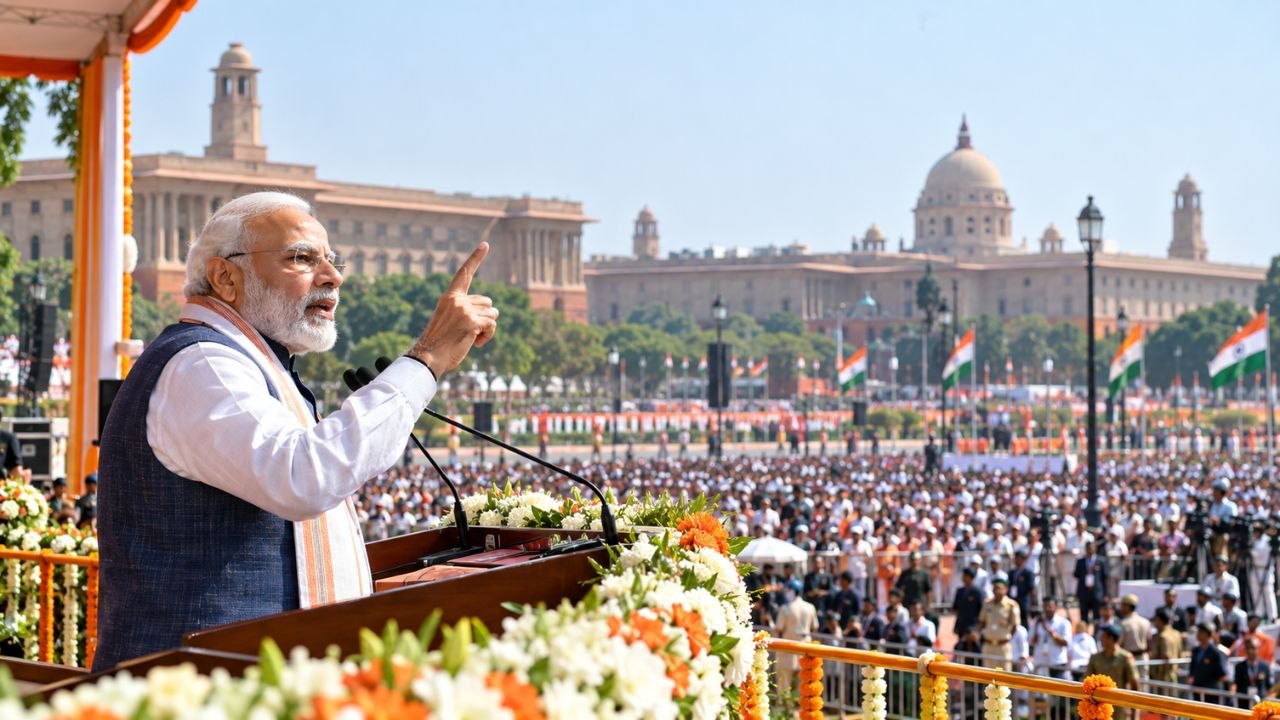
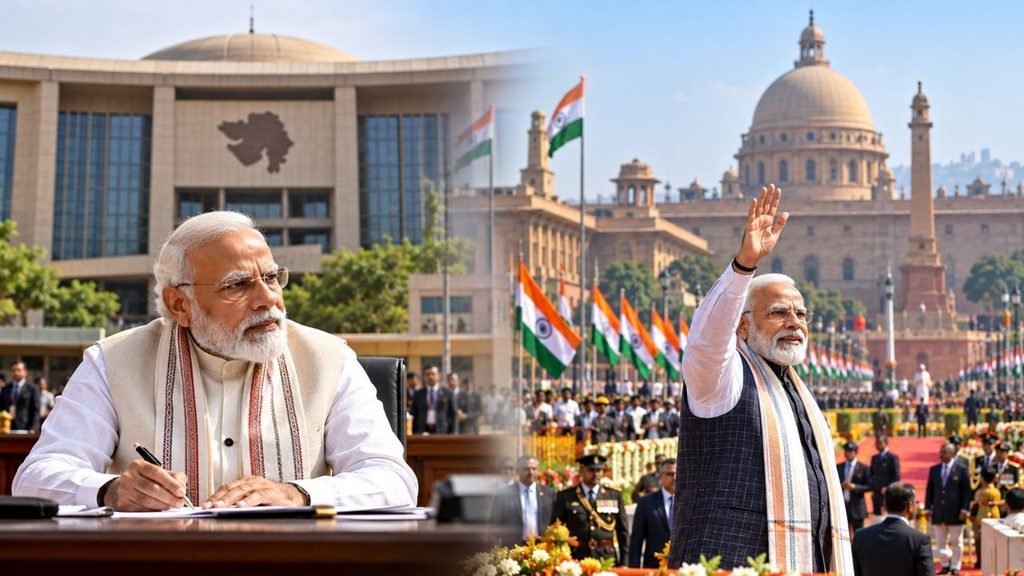
October 7, 2026, marked a rare milestone in Indian politics. On this day, Prime Minister Narendra Modi completed 25 straight years as the head of a government. His journey began on October 7, 2001, when he took oath as the Chief Minister of Gujarat, and continued when he became Prime Minister of India in 2014. What makes this milestone stand out is that Modi has never lost an election as an incumbent, whether in Gujarat or at the national level. From leading a state to leading the country, his 25-year run covers both phases of his political career. The occasion was observed with a Union Cabinet resolution, a nationwide celebration campaign, a temple visit and an address to the nation.
From Gujarat Chief Minister to Prime Minister
Narendra Modi’s first big role in government came on October 7, 2001, when he was appointed Chief Minister of Gujarat, succeeding Keshubhai Patel. At that time, Gujarat was still recovering from the devastating Bhuj earthquake, and the state needed steady leadership. Modi went on to win three straight assembly elections in 2002, 2007 and 2012, which kept him in charge of Gujarat until 2014. That year, after leading the BJP to a national victory, he moved to Delhi and became Prime Minister on May 26, 2014. He then won the Lok Sabha elections again in 2019 and 2024, which means he has now served three consecutive terms as Prime Minister.
Narendra Modi’s Leadership Timeline: 2001 to 2026
The 25-year journey can be divided into two clear phases, each one building on the other.
Chief Minister of Gujarat: 2001 to 2014
Modi’s time as an executive leader started on October 7, 2001, when he became Gujarat’s Chief Minister. Over the next 13 years, he led the state through three assembly elections, winning in 2002, 2007 and 2012.
Key points from this phase:
- Took oath as Gujarat Chief Minister on October 7, 2001
- Succeeded Keshubhai Patel at a time when Gujarat was recovering from the Bhuj earthquake
- Won three consecutive assembly elections in 2002, 2007 and 2012
- Became one of the longest-serving Chief Ministers in Gujarat’s history
- Left the state role in 2014 to step into national politics
Prime Minister of India: 2014 to Present
On May 26, 2014, Modi became the Prime Minister of India after the BJP’s national victory. He then secured majorities in the 2019 and 2024 Lok Sabha elections, giving him three consecutive terms in office.
Key points from this phase:
- Became Prime Minister on May 26, 2014
- Won the 2019 Lok Sabha elections for a second term
- Won the 2024 Lok Sabha elections for a third consecutive term
- Has led the country for more than a decade at the national level
Key Commemorations and Events on October 7
The 25-year milestone was marked by several events and official recognitions on October 7, 2026. Each of these events reflected a different side of the occasion, from official recognition to public outreach and spiritual reflection.
Union Cabinet Resolution
On October 6, 2026, the Union Cabinet passed a special resolution congratulating Prime Minister Modi on completing 25 years as head of a government. The resolution described his tenure as a testament to public trust and a showcase of Indian democracy. Information and Broadcasting Minister Ashwini Vaishnaw briefed the media about the resolution, which gave the milestone an official stamp of recognition.
Seva Sankalp Abhiyan
The BJP launched a month-long celebration called the “Seva Sankalp Abhiyan”, which ran from September 17 to October 17. The campaign included nationwide outreach programmes and “Seva Yatras” that connected Vadnagar, Modi’s hometown, with Varanasi, his Lok Sabha constituency. The idea behind the campaign was to highlight the theme of public service and reach citizens across different states.
Temple Visit
On the morning of October 7, Prime Minister Modi visited the Shri Vinayaka Temple in Sarojini Nagar, New Delhi. He performed an aarti and offered prayers for the progress of the nation and the welfare of its citizens. The visit added a personal and spiritual dimension to the day’s observances.
Address to the Nation
Later in the day, Modi spoke at the Viksit Bharat Sankalp Sabha in Delhi. In his address, he said his 25 years at the helm were driven by a “mission rather than personal ambition.” He bowed before the public and gave credit for his long political journey to the trust of the Indian people. The speech focused on national progress and the importance of public service.
Political Records and Significance
Modi’s 25-year run as head of a government stands out for several reasons. These records help explain why the milestone has drawn so much attention across the country.
Uninterrupted Executive Run
The 25-year period represents an unbroken stretch of executive leadership, first in Gujarat and then at the Centre. Very few leaders in Indian political history have held the top executive position in a government for such a long, continuous period. This uninterrupted run is one of the most striking features of his career.
Non-Congress Record
Modi is described as the longest-serving non-Congress Prime Minister. He is also the only leader born after Independence to secure a majority on his own in the Lok Sabha. These two records place him in a category of his own among India’s Prime Ministers.
Electoral Consistency
Along with Jawaharlal Nehru, Modi is the only Prime Minister to have secured three consecutive national election victories. His record also includes three straight Gujarat assembly wins in 2002, 2007 and 2012, followed by three Lok Sabha wins in 2014, 2019 and 2024. This kind of consistency at the ballot box is rare and forms an important part of his political story.
A 25-Year Political Journey
Looking back, Narendra Modi’s journey from taking oath as Gujarat Chief Minister on October 7, 2001, to continuing as Prime Minister since 2014 has now reached the 25-year mark. The milestone brings together his years leading Gujarat and his time leading the country. October 7, 2026, was marked by a Union Cabinet resolution, the Seva Sankalp Abhiyan, a temple visit and an address at the Viksit Bharat Sankalp Sabha. Taken together, these events reflect both the official and public sides of the occasion. For anyone following Indian politics, the 25-year milestone offers a clear reference point for understanding the scale and continuity of Modi’s leadership.
Conclusion
Narendra Modi 25 Years as head of government is a milestone that covers his journey from Gujarat Chief Minister in 2001 to Prime Minister of India since 2014. Over this period, he won three consecutive Gujarat assembly elections and three consecutive Lok Sabha elections. He became the longest-serving non-Congress Prime Minister and one of only two Prime Ministers to secure three straight national victories. The occasion was marked by a Union Cabinet resolution, the Seva Sankalp Abhiyan, a temple visit and an address at the Viksit Bharat Sankalp Sabha. The milestone reflects 25 uninterrupted years in executive office, covering both state and national leadership.
Frequently Asked Questions
Q1. What is the significance of Narendra Modi completing 25 years in government?
A1. On October 7, 2026, Narendra Modi completed 25 years of continuous service as head of a government, starting as Gujarat Chief Minister in 2001 and continuing as Prime Minister of India since 2014.
Q2. When did Narendra Modi first become the Chief Minister of Gujarat?
A2. Narendra Modi was first appointed as Gujarat Chief Minister on October 7, 2001, succeeding Keshubhai Patel, at a time when Gujarat was recovering from the Bhuj earthquake.
Q3. How many elections has Narendra Modi won as an incumbent?
A3. Modi won three consecutive Gujarat assembly elections in 2002, 2007 and 2012, followed by three consecutive Lok Sabha elections in 2014, 2019 and 2024.
Q4. What events marked the 25-year milestone on October 7, 2026?
A4. The milestone was marked by a Union Cabinet resolution passed on October 6, the month-long Seva Sankalp Abhiyan, a visit to the Shri Vinayaka Temple in Sarojini Nagar and an address at the Viksit Bharat Sankalp Sabha in Delhi.
Q5. What records does Narendra Modi hold in Indian political history?
A5. Modi is described as the longest-serving non-Congress Prime Minister and the only leader born after Independence to secure a majority on his own in the Lok Sabha. Alongside Jawaharlal Nehru, he is the only Prime Minister to secure three consecutive national election victories.