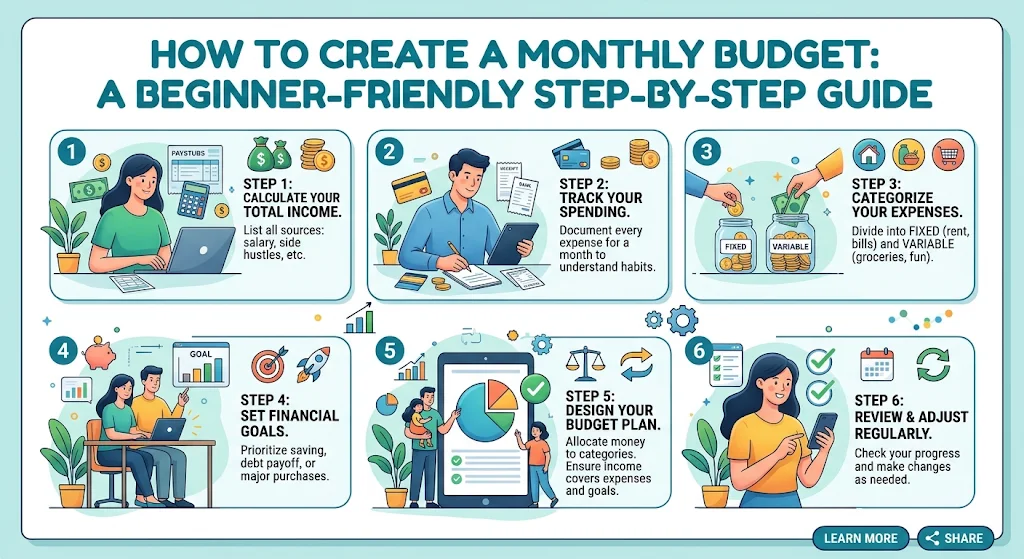
If you have ever reached the end of the Monthly Budget wondering where your money went, you are not alone. The fix is rarely a bigger paycheck. It is usually a clear plan, and the best way to get one is to create a monthly budget that matches how you actually live.
A budget is simply a written plan for your income and your spending. It tells your money where to go before it disappears. Done well, it reduces stress, helps you pay bills on time, and creates space for savings and the things you enjoy.
This guide walks you through seven practical steps, compares popular budgeting methods, and shows a worked example you can copy. The core ideas work in any country and currency. Where rules differ by location, we say so.
Table of Contents
- What is a monthly budget and why does it matter?
- 7 steps to create a monthly budget
- Budgeting methods compared
- A sample monthly budget
- How to budget with an irregular income
- Common budgeting mistakes to avoid
- Worldwide advice vs. country-specific rules
- Frequently asked questions
- Conclusion
What Is a Monthly Budget and Why Does It Matter?
A monthly budget is a plan that compares the money you expect to receive in a month with the money you expect to spend. At its simplest, it answers three questions: how much comes in, how much goes out, and what is left over.
Many people avoid budgeting because it sounds restrictive. In reality, a budget gives you permission to spend. When you know your bills are covered and your savings are on track, you can enjoy the rest without guilt.
The U.S. Consumer Financial Protection Bureau (CFPB) describes budgeting as a core money-management habit and publishes free guidance on how to create a budget and stick with it. Its advice is a useful reminder that a budget is a tool you adjust over time, not a test you pass or fail.
7 Steps to Create a Monthly Budget
Step 1: Set a Clear Goal
Before you open a spreadsheet, decide why you want to create a monthly budget. A goal makes the effort feel worthwhile. Good starting goals include:
- Building a small emergency fund
- Paying off a credit card
- Saving for a deposit, a trip or a major purchase
- Simply ending each Monthly Budget with money left over
Make your goal specific. “Save more” is vague, while “save 500 by the end of June” is something you can track.
Step 2: Gather Your Financial Information
Collect the documents that show your real numbers. These usually include:
- Recent payslips or records of other income
- Bank and credit card statements from the last two or three months
- Bills for rent or mortgage, utilities, phone, internet and insurance
- Loan statements, such as car, student or personal loans
- Records of subscriptions and memberships
Looking back two or three months matters because it shows what you actually spend, not what you think you spend. Most people are surprised by at least one category.
Step 3: Calculate Your Monthly Take-Home Income
Use your net income, which is the money that actually reaches your account after tax and deductions. Budgeting with your gross salary is a common beginner error and leads to plans you cannot afford.
Add up every regular source of money:
- Salary or wages after deductions
- Side income or freelance earnings
- Benefits, pensions or regular support payments
- Rental income or other recurring income
If your income varies from month to month, use your lowest typical month as your baseline. We cover this in more detail below.
Step 4: List All Your Expenses
Now list everything you spend money on. Split your expenses into two groups, because they behave differently.
Fixed expenses stay about the same each month:
- Rent or mortgage
- Insurance premiums
- Loan repayments
- Subscriptions and memberships
- Internet and phone contracts
Variable expenses change from month to month:
- Groceries
- Electricity, gas and water
- Fuel or public transport
- Dining out and entertainment
- Clothing and personal care
- Medical costs
Do not forget irregular expenses that arrive only a few times a year, such as annual insurance, school fees, car servicing, holiday gifts and festival costs. Add them up, divide by twelve, and include that amount in your monthly plan. This simple habit prevents many “unexpected” bills.
Step 5: Choose a Budgeting Method That Suits You
There is no single best system. The right method is the one you will actually use. Here are four popular options.
| Method | How it works | Best for |
|---|---|---|
| 50/30/20 rule | About 50% of take-home pay for needs, 30% for wants and 20% for savings and debt repayment | Beginners who want a simple framework |
| Zero-based budget | Give every unit of income a job until income minus planned spending equals zero | People who want full control over each dollar |
| Envelope method | Place cash for each category in a labelled envelope and stop spending when it is empty | People who overspend with cards |
| Pay yourself first | Move savings out of your account on payday and spend what remains | People who struggle to save |
The 50/30/20 guideline was popularised by U.S. Senator Elizabeth Warren and her co-author Amelia Warren Tyagi. Treat it as a starting point, not a rule. If rent and bills already take more than half of your pay, adjust the percentages to match your reality, and then work to improve them gradually. If your budget is very tight, our guide on how to save money on a low income shows how to build savings from small amounts.
Step 6: Set Spending Limits and Savings Targets
Assign a limit to each category. Start with your essentials, then your debt payments, then your savings, and only then divide what remains among flexible spending.
A few guidelines help here:
- Pay essentials first. Housing, utilities, food, transport and minimum debt payments come before wants.
- Include savings as a bill. Treat your savings transfer as a fixed expense, not as leftovers.
- Plan for fun. A small, deliberate “fun money” category makes the budget easier to stick with.
- Add a buffer. A small “miscellaneous” line absorbs the small surprises that every month brings.
If you are building an emergency fund, aim for a small starting target first, then grow it over time. The CFPB’s Start Small, Save Up initiative encourages people to start with whatever amount is realistic.
Step 7: Track, Review and Adjust
A budget only works if you compare it with reality. Track your spending as you go, using whichever method you will keep up: a notebook, a spreadsheet, a banking app or a budgeting app. The CFPB offers a free spending tracker worksheet if you prefer paper or a simple file.
At the end of each month, spend 20 minutes reviewing:
- Which categories went over, and why?
- Which categories had money left over?
- Did you reach your savings goal?
- Do any amounts need to change next month?
Your first budget will be imperfect, and that is normal. Most people need two or three months to find limits that feel realistic. Adjusting is not failure. It is the process working.
A Sample Monthly Budget
The example below is hypothetical. It is designed to show how the 50/30/20 approach looks in practice for a take-home income of 3,000 per month. Your amounts will differ, so replace each number with your own.
| Category | Type | Monthly amount |
|---|---|---|
| Rent | Need | 900 |
| Utilities and phone | Need | 150 |
| Groceries | Need | 350 |
| Transport | Need | 100 |
| Total needs (50%) | 1,500 | |
| Dining out | Want | 250 |
| Subscriptions | Want | 50 |
| Entertainment | Want | 200 |
| Shopping | Want | 250 |
| Personal spending | Want | 150 |
| Total wants (30%) | 900 | |
| Emergency fund | Savings | 300 |
| Extra debt payment | Savings/Debt | 200 |
| Goal savings (holiday, deposit) | Savings | 100 |
| Total savings and debt (20%) | 600 | |
| Grand total | 3,000 |
Notice that income minus planned spending equals zero. Every unit of money has a purpose, including savings. If your rent alone is higher, reduce the “wants” first, but keep at least a small amount going to savings.
How to Budget with an Irregular Income
Freelancers, gig workers, commission earners and seasonal workers face a harder task, because their paychecks change. These habits help:
- Budget from your lowest month. Plan essentials around the least you usually earn.
- Save the surplus. In stronger months, move extra income into a buffer account to cover weaker months.
- Pay yourself a “salary”. Move income into a separate account, then pay yourself a fixed amount each month.
- Set aside tax money. If you are responsible for your own tax, move a portion of each payment into a separate account straight away. Confirm the correct percentage with your local tax authority.
Common Budgeting Mistakes to Avoid
- Being too strict. A budget with no room for enjoyment is hard to keep. Allow a small, planned amount for fun.
- Using gross instead of net income. You can only spend what you actually receive.
- Forgetting irregular costs. Annual and seasonal bills break many budgets.
- Not tracking. A plan you never compare with real spending is just a wish.
- Giving up after one bad month. Overspending once does not mean budgeting does not work. Review what happened and adjust.
- Skipping the emergency fund. Without a cushion, one unexpected bill can undo your plan and push you toward debt.
- Using someone else’s numbers. A popular template is a starting point only. Your budget should reflect your income, location and priorities.
Worldwide Advice vs. Country-Specific Rules
The steps in this guide, such as listing income, tracking expenses and reviewing monthly, work anywhere in the world. Some details, however, depend on your country:
- Taxes and deductions: Your take-home pay depends on local tax and social contribution rules.
- Benefits and tax credits: Eligibility and amounts vary by country and region.
- Banking products: Account fees, savings rates and deposit protection differ between countries and providers.
- Credit and debt rules: Interest limits, lender regulation and consumer rights are set locally.
When your decision involves tax, benefits or legal rights, check with an official government source or a qualified local adviser. This article provides general education, not personalised financial advice. Please read our Disclaimer for details.
Frequently Asked Questions
What is the easiest way to create a monthly budget for beginners?
Start with the 50/30/20 framework. List your take-home pay, assign roughly half to needs, 30% to wants and 20% to savings and debt, then adjust to fit your real expenses. Track your spending for a month to see how close your plan is to reality.
How often should I review my monthly budget?
Review it at least once a month, ideally on the same date each time. If you are just starting out or your income changes, a quick weekly check helps you catch overspending early.
Should I use a spreadsheet, an app or pen and paper?
Use whichever you are most likely to keep using. A spreadsheet offers flexibility, apps automate tracking, and pen and paper feels simple and visual. Whatever you choose, check that any app has a clear privacy policy and no hidden fees.
How much of my income should go to savings?
There is no single correct figure. Many guidelines suggest around 20% for savings and debt repayment, but that may be unrealistic at first. Start with an amount you can sustain, even if it is small, and increase it as your finances improve.
What if my expenses are higher than my income?
First, double-check that you have counted every income source. Then look for cuts in flexible categories, review recurring bills and ask providers for cheaper plans. If essentials alone exceed your income, look into local assistance programmes, speak to your creditors early, and consider free credit or debt counselling services in your country.
Can couples or families create a monthly budget together?
Yes, and it often works better when everyone is involved. Agree on shared goals, list joint bills, decide how each person contributes, and set aside personal spending money for each adult so no one feels controlled. Review the budget together regularly.
Conclusion
To create a monthly budget that lasts, keep it simple. Set a clear goal, gather your real numbers, calculate your net income, list fixed and variable expenses, choose a method that suits you, set limits, and review every month. Your first attempt will not be perfect, and it does not need to be.
What matters is the habit of looking at your money on purpose. Once you create a monthly budget and follow it for a few months, you will understand your spending, handle surprises more calmly and make steady progress toward your goals. If money is especially tight, start with our guide to saving money on a low income and build from there.
Have a question about budgeting or a topic you would like us to cover? Contact Us, or learn more about the team behind these guides on our About Us page.