
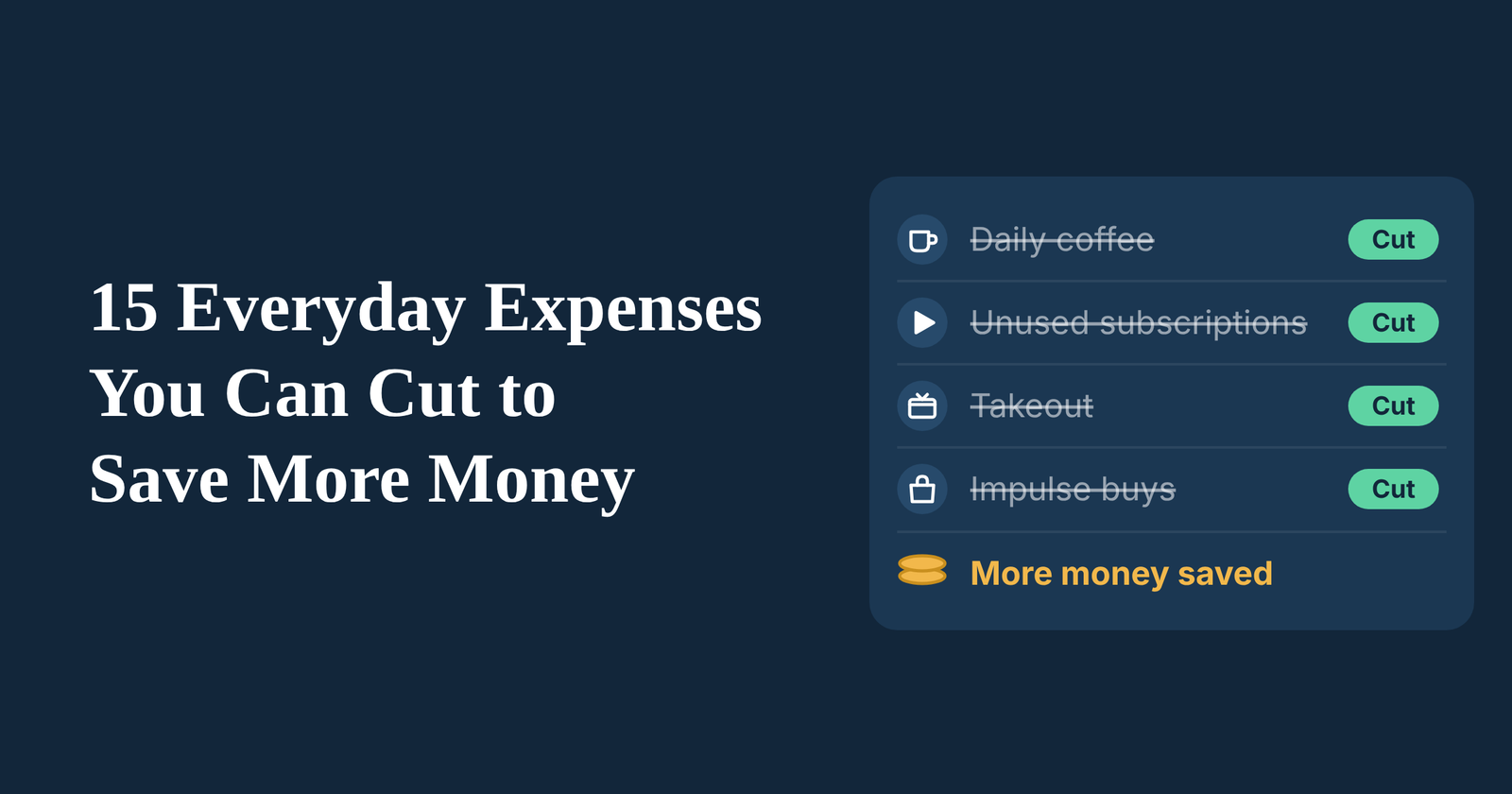
Most households do not have a spending problem so much as a leak problem. Small, forgettable charges add up quietly, and the everyday expenses you can cut are often the ones you barely notice. A daily takeaway coffee, a forgotten subscription or an unnecessary bank fee will not ruin your finances on its own, but together they can take a surprising bite out of your income.
This guide lists 15 everyday expenses you can cut without wrecking your lifestyle. Each one comes with practical steps and a note on what to watch for. The advice is meant to work in any country, and we point out where rules or prices vary by location. This article is general education, not personalised financial advice.
Table of Contents
- How to find the everyday expenses you can cut
- 15 everyday expenses you can cut to save more money
- How much could small cuts add up to?
- Where to put the money you save
- Common mistakes when cutting expenses
- Worldwide advice vs. country-specific rules
- Frequently asked questions
- Conclusion
Before You Start: How to Find the Everyday Expenses You Can Cut
The fastest way to spot the everyday expenses you can cut is to look at what you actually spend, not what you think you spend. Gather the last two or three months of bank and card statements, then highlight every recurring or optional payment.
The U.S. Consumer Financial Protection Bureau offers a free Cutting Expenses worksheet that walks you through deciding which spending to reduce. If you want to see the bigger picture first, our guide on how to create a monthly budget shows you how to organise your income and spending in one place.
As you review each expense, ask three simple questions:
- Do I use it? If not, cancel it.
- Do I value it? If it brings little joy or benefit, reduce it.
- Can I get it cheaper? If yes, switch or negotiate.
One important rule: never cut spending on essential health, safety or legal requirements, such as necessary medication or legally required insurance. Look for savings in other places first.
15 Everyday Expenses You Can Cut to Save More Money
1. Takeaways and Food Delivery
Prepared food costs far more than cooking the same meal at home, and delivery adds fees, service charges and tips. Among all the everyday expenses you can cut, this is often the largest. Set a monthly limit rather than banning it completely, cook larger batches on quieter days, and keep a few simple emergency meals at home so you are less tempted when you are tired.
2. Daily Coffee, Snacks and Drinks
A single daily purchase may seem harmless, but a small amount multiplied by every working day becomes a real number. Make coffee at home, carry a reusable bottle and keep snacks in your bag. You do not have to give up treats entirely. Just save them for moments you will truly enjoy.
3. Unused Subscriptions and Memberships
Streaming services, apps, gym memberships, magazines and cloud storage often renew automatically, and it is easy to forget them. Subscriptions are among the easiest everyday expenses you can cut because cancelling takes minutes and costs you nothing you were really using. Review your statements for recurring charges, cancel what you have not used in the past month, and rotate streaming services instead of paying for several at once.
4. Wasted Groceries and Impulse Supermarket Buys
Food you throw away is money you have already spent. The U.S. Environmental Protection Agency notes that planning meals and buying only what you need are effective ways to reduce wasted food at home and save money. Write a meal plan, check your cupboards before shopping, freeze leftovers and use older items first. Shopping with a list and avoiding hunger-driven trips also helps.
5. Brand-Name Staples
For basics such as rice, flour, pasta, cleaning products, painkillers and toiletries, store brands and generics are often cheaper and similar in quality. Try swapping a few items at a time and keep the ones you are happy with. Compare unit prices rather than package prices to find the real bargain.
6. Bank Fees
Monthly account fees, overdraft charges, ATM fees and foreign transaction fees are everyday expenses you can cut with a single phone call or a switch of account. Ask your bank to waive fees, set up low-balance alerts, use in-network ATMs and compare accounts with lower charges. Our guide to checking account vs savings account explains how to choose the right account setup so you avoid unnecessary costs.
7. Credit Card Interest and Late Fees
Interest and late fees are among the most expensive everyday costs because they pay for nothing. Pay your statement balance in full when you can, set up automatic payments for at least the minimum, and pay down high-interest balances first. Avoiding missed payments also protects your credit history, so see our guide to improving your credit score for the next step.
8. Mobile Phone and Internet Plans
Many people pay for more data, speed or channels than they use. Check your actual usage, then ask your provider for a cheaper plan or compare offers from other providers. Consider a SIM-only or prepaid plan if you do not need a bundled device. Loyalty rarely earns a discount unless you ask for one.
9. Standby Power and Wasteful Energy Habits
Many devices keep drawing power even when they seem off. ENERGY STAR notes that using a power strip for computers and related equipment lets you fully disconnect them and eliminate standby power use. It is one of those everyday expenses you can cut with almost no effort. Also switch to efficient LED bulbs, wash clothes at lower temperatures, air-dry laundry when possible and avoid heating or cooling empty rooms. ENERGY STAR publishes a helpful list of low- and no-cost energy-saving tips.
10. Insurance You Have Not Shopped Around For
Premiums for home, contents, vehicle and other policies can creep up over time. Once a year, compare quotes, check for discounts, and make sure you are not paying for cover you do not need. Be careful not to lower cover that protects you from serious loss. The goal is a better price for the same protection, not a weaker policy.
11. Impulse Shopping and Online “Add to Cart” Buys
One-click payment, saved cards and constant marketing make impulse buying effortless. Try a waiting rule: put non-essential items on a list and wait 24 to 48 hours before buying. For bigger items, wait a week or more. Unsubscribing from promotional emails and removing saved card details also reduces temptation. Impulse shopping is one of the everyday expenses you can cut without feeling any real loss, because many wanted items lose their appeal after a day or two.
12. Short Taxi and Rideshare Trips
Short, habitual rides can be expensive. Walk or cycle for short distances, use public transport passes if you commute often, and share rides with colleagues or friends. If you own a vehicle, keeping tyres inflated and following the maintenance schedule can also reduce fuel and repair costs over time.
13. Entertainment, Games and In-App Purchases
Cinema tickets, events, mobile games and in-app purchases can add up fast, especially when they are small and frequent. Look for free or low-cost alternatives such as libraries, community events, free-to-play options without spending, and discounted off-peak tickets. Turn off one-tap purchasing on shared or children’s devices.
14. Gifts and Occasion Spending
Celebrations matter, but spending pressure can be hard on your budget. Set a gift budget for the year and divide it by month. Consider homemade gifts, shared group gifts, or agreeing with friends and family to set a spending limit or draw names. A thoughtful gesture often means more than a large price tag.
15. Disposable and Convenience Products
Bottled water, paper plates, single-use wipes, pre-cut produce and other convenience items cost more over time than reusable or basic versions. Switch to a refillable bottle, washable cloths and whole produce you cut yourself. Check that tap water is safe where you live before relying on it, since this varies by location.
How Much Could Small Cuts Add Up To?
The table below shows a hypothetical example. Your numbers will differ, so treat it as a way to see how small changes combine, not as a prediction.
| Expense you trim | Hypothetical monthly saving |
|---|---|
| Takeaways and delivery | 40 |
| Unused subscriptions | 15 |
| Coffee and snacks | 20 |
| Phone plan | 10 |
| Energy bills | 12 |
| Impulse shopping | 30 |
| Bank fees | 8 |
| Wasted groceries | 20 |
| Total | 155 per month |
At 155 a month, that is about 1,860 over a year. That figure comes from simple arithmetic, not from a guarantee. The point is that the everyday expenses you can cut tend to be small on their own, and the real impact comes from combining several of them.
Where to Put the Money You Save
Money you free up has a way of disappearing unless it has a destination. Decide in advance where it will go:
- An emergency fund, so surprise bills do not become debt. If you are starting small, our guide on how to save money on a low income shows how to build a cushion from small amounts.
- High-interest debt, which often costs more than savings can earn.
- A separate savings account, funded by an automatic transfer on payday. Treat the transfer as a bill you pay yourself.
- A specific goal, such as a trip, a deposit or an annual bill.
Make the transfer automatic and send it the day your income arrives. The everyday expenses you can cut will only help if the money you free up actually gets saved.
Common Mistakes When Cutting Expenses
- Trying to cut everything at once. Cutting every one of the everyday expenses you can cut in a single month is hard to sustain. Start with two or three, then add more.
- Cutting joy completely. A budget with no fun is hard to keep. Keep a small, planned amount for things you enjoy.
- Switching to something cheaper that costs more later. Very cheap products that wear out quickly can be poor value. Compare cost per use.
- Cancelling something you need. Do not drop essential insurance, health care or legal requirements to save money.
- Forgetting to redirect the savings. If the money is not moved, it tends to be spent elsewhere.
- Falling for “deals” that tempt you to spend. A discount on something you did not plan to buy is not a saving.
- Never reviewing. Prices, plans and habits change. Review your spending every few months.
Worldwide Advice vs. Country-Specific Rules
The principle behind these 15 everyday expenses you can cut is universal: find the spending that gives you the least value, trim it, and move the savings somewhere useful. But details vary by country:
- Prices and providers: Phone, internet, energy and insurance markets differ widely, as do the discounts available.
- Bank fees and account rules: Overdraft rules, ATM charges and account types depend on local regulation and the provider.
- Consumer rights: Cancellation rules, notice periods and contract terms vary, so read the terms before you cancel.
- Water and food safety: Tap water quality and shopping habits differ, so use local guidance.
- Public benefits and discounts: Concessions for students, seniors, low-income households and others depend on your government and local authority.
For decisions involving contracts, insurance or legal rights, check with an official source or qualified local adviser. Please read our Disclaimer for more information.
Frequently Asked Questions
What are the easiest everyday expenses you can cut first?
The easiest everyday expenses you can cut first are usually unused subscriptions, avoidable bank fees and food waste. They need little change to your lifestyle, and you can often fix them in one sitting. Takeaways, impulse buys and phone plans are good next steps.
How much money can I save by cutting everyday expenses?
It depends on your income and habits, so there is no universal number. Many households find that trimming a handful of the everyday expenses you can cut frees up a meaningful monthly amount. Track your spending for a month to see what is realistic for you.
Will cutting everyday expenses make my life worse?
Not if you do it thoughtfully. Focus first on spending that brings you little value, and keep a small, planned amount for things you enjoy. The aim is to spend on what matters to you, not to cut everything.
Should I cut all my everyday expenses at once?
No. Changing everything at once is hard to maintain. Pick two or three areas, set small goals and build from there. Gradual changes are more likely to last.
Which expenses should I never cut?
Avoid cutting essential health care, legally required insurance, safety-related repairs and minimum debt payments. Missing these can create bigger costs later. If you are struggling to pay essentials, contact your providers or local support services early.
How do I keep the savings from disappearing?
Move the money as soon as you free it up. Set an automatic transfer to a savings account on payday, and give each saved amount a purpose, such as an emergency fund or debt repayment.
Conclusion
You do not need a dramatic lifestyle change to save more. The everyday expenses you can cut are often hiding in plain sight: delivery fees, forgotten subscriptions, avoidable bank charges, wasted groceries and standby power. Start with the easiest ones, work through the list at your own pace, and move the money you free up into savings or debt repayment right away.
Pick just three items from this list and act on them this week. Review your progress after a month, then add a few more. Over time, the everyday expenses you can cut will add up to real breathing room, and a budget that finally works for you.