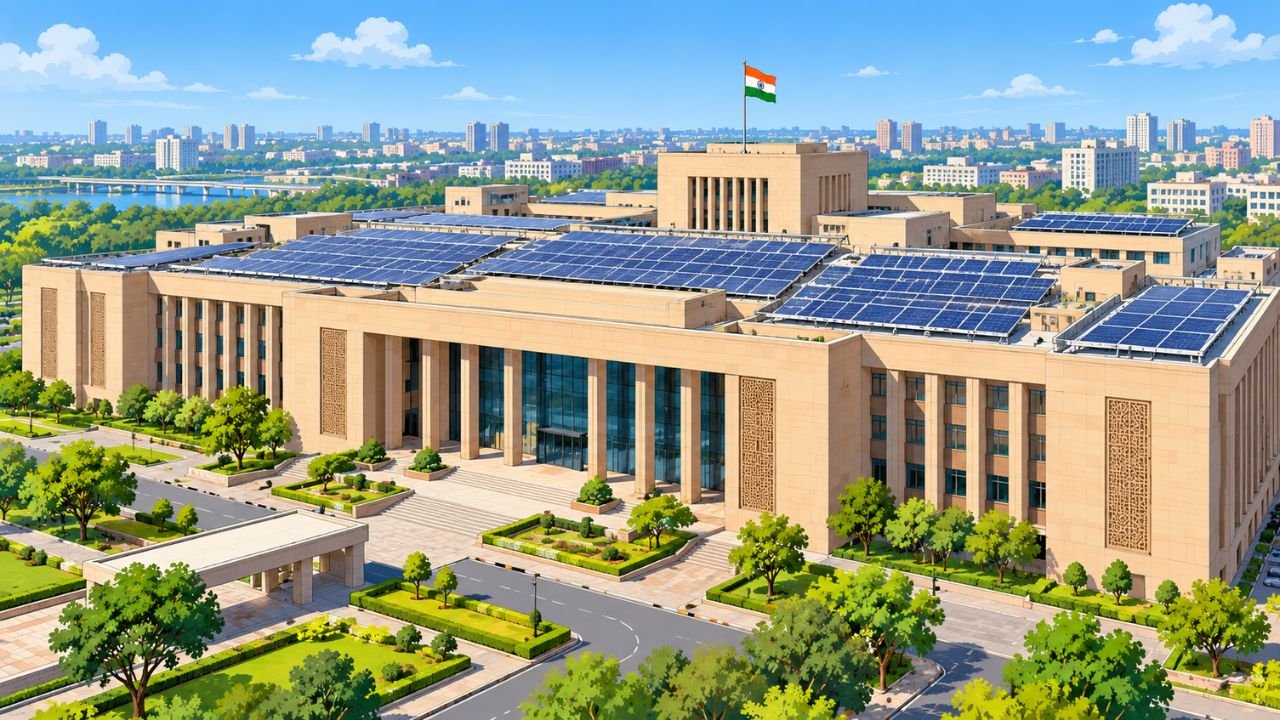
The Gujarat government has launched a major expansion of grid-connected rooftop solar installations across public infrastructure. Led by the Gujarat Energy Development Agency (GEDA) under the Climate Change Department, the initiative is being expanded to improve energy consumption and reduce government expenditure on conventional electricity. The programme is building on the state’s earlier rooftop solar installations and has set a significantly larger target for the 2026-27 financial year. Under the latest plan, thousands of additional government buildings will receive rooftop solar systems connected to the public grid. With a budget of ₹314 crore and a target of 15,000 new buildings, this expansion marks one of Gujarat’s biggest pushes yet toward distributed solar generation on government infrastructure.
6,014 Government Buildings Already Equipped With Solar
By the end of the previous fiscal year, up to March 2026, a total of 6,014 government buildings had already been equipped with rooftop solar installations. These installations together represented a cumulative solar capacity of 95 MW. Out of the total, 1,377 government buildings were added during FY 2025-26 alone, contributing 17.1 MW of solar capacity. The latest expansion is therefore being planned on top of an existing network of rooftop solar installations across government infrastructure. This steady growth over previous years shows that the programme has moved from a pilot phase to a full-scale rollout, with more buildings being added every year.
2026-27 Target: 15,000 More Government Buildings
For 2026-27, the Gujarat government has set its largest expansion target yet under the programme. The government is targeting an additional 15,000 government buildings, with the new installations expected to add 65 MW of solar capacity to the public grid. This expansion is focused on increasing distributed solar generation directly through government infrastructure while continuing the wider rooftop solar programme across the state. The scale of the target reflects the state’s intent to make government buildings a major source of clean energy, reducing the load on conventional power sources and lowering long-term electricity costs for public offices.
₹314 Crore Budget for the 2026-27 Rollout
The rooftop solar installations receive 100% financial backing for capital costs directly through the state budget. For the 2026-27 rollout, the state government has allocated ₹314 crore. The funding is divided among different categories of government buildings.
| Category | Allocation |
|---|---|
| General Government Buildings | ₹278 crore |
| Tribal Development Department Buildings | ₹33 crore |
| Social Justice and Empowerment Department Buildings | ₹3 crore |
| Total | ₹314 crore |
The allocation provides the financial structure for the planned expansion across the targeted government buildings. The largest share, ₹278 crore, goes to general government buildings, while specific allocations have been made for buildings under the Tribal Development Department and the Social Justice and Empowerment Department. This category-wise distribution ensures that the programme reaches different sections of government infrastructure rather than focusing on a single type of building.
High-Tech Digital Monitoring System
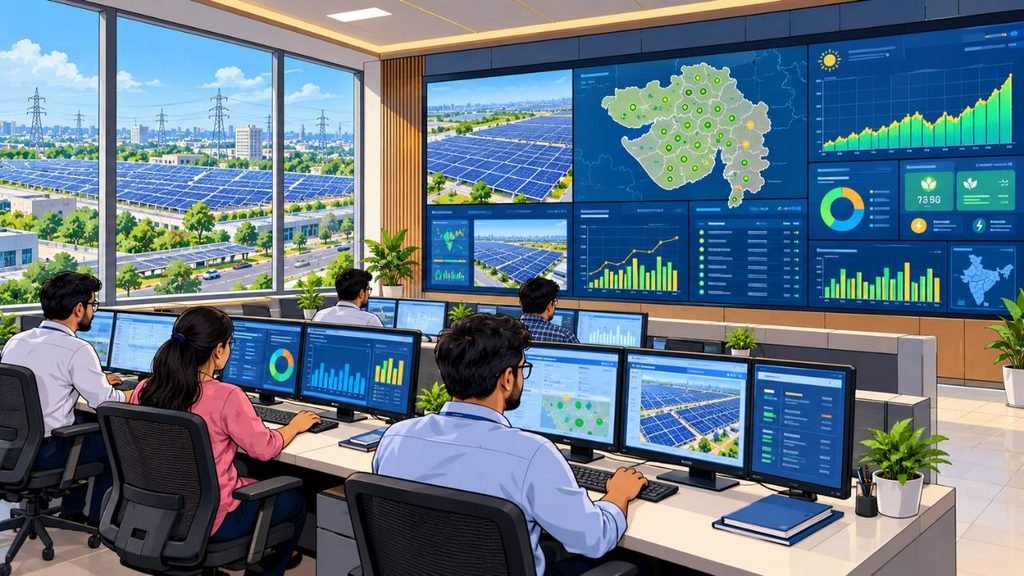
Alongside the expansion of rooftop solar, Gujarat has integrated an Industrial Internet of Things (IIoT)-based Renewable Energy Monitoring System to monitor the performance of renewable energy installations. The system connects smart meters, sensors and communication gateways through GPRS, 4G and Ethernet. Its monitoring framework records performance data every 15 minutes, generating up to 96 daily readings. It can also trigger automated remote alerts when technical errors or transmission abnormalities are detected. This allows the performance of the connected renewable energy installations to be monitored through a unified digital system. The real-time monitoring helps officials identify issues quickly and take corrective action without waiting for manual inspections.
142.5 MW of Solar Power Already Monitored
The unified digital dashboard already monitors 142.5 MW of total solar power across the state. It also monitors 68.3 MW of wind assets. The system therefore provides a centralized monitoring framework for both solar and wind renewable energy assets. The continuous data collection and automated alerts are designed to help identify technical or transmission-related abnormalities. By bringing both solar and wind assets onto a single platform, the state has created a monitoring system that gives a complete picture of renewable energy performance and helps maintain steady output from these installations.
Strategic and Ecological Impact
The project aligns with Gujarat’s position as India’s leading state in installed renewable energy capacity, which stands at 47,178 MW, according to the Union Ministry of New and Renewable Energy. By focusing on distributed solar generation directly on administrative buildings, the initiative is aimed at decreasing carbon emissions and reducing dependence on the grid. The programme also seeks to turn public infrastructure into self-sustaining power units, while expanding the use of rooftop solar across government buildings. Over time, this approach can reduce the government’s electricity bills, lower the carbon footprint of public offices and create a visible model of clean energy adoption that other states and private institutions can follow.
Gujarat’s Rooftop Solar Expansion
With 6,014 government buildings already equipped with rooftop solar and a new target of 15,000 additional buildings for 2026-27, Gujarat is significantly expanding its grid-connected rooftop solar programme. The state has allocated ₹314 crore for the latest rollout, targeting 65 MW of new solar capacity. At the same time, the IIoT-based monitoring system provides digital monitoring of renewable energy assets, including 142.5 MW of solar power and 68.3 MW of wind assets. The 2026-27 expansion represents the next major stage of Gujarat’s government rooftop solar initiative, and it builds on years of steady progress in adding solar capacity to public buildings.
What Citizens and Officials Need to Know
For citizens and government officials in Gujarat, this expansion means more public buildings will soon run partly on solar power. Government offices, tribal development buildings and social justice department buildings will be among those equipped with rooftop solar systems under the new plan. The ₹314 crore budget ensures that capital costs are fully covered by the state, so individual departments do not need to arrange their own funding. The IIoT-based monitoring system will track the performance of these installations in real time, which should help in faster detection of faults and better maintenance. Over time, this initiative is expected to reduce the government’s electricity expenses and contribute to Gujarat’s overall renewable energy targets. Citizens can also expect to see solar panels on more government buildings in their districts as the rollout progresses.
Conclusion
Gujarat Rooftop Solar expansion is set to add 15,000 government buildings to the state’s grid-connected solar network in 2026-27, with a target of 65 MW of new capacity and a budget of ₹314 crore. The programme builds on the 6,014 buildings already equipped with rooftop solar, which together represent 95 MW of cumulative capacity. The state has also deployed an IIoT-based monitoring system that tracks 142.5 MW of solar power and 68.3 MW of wind assets through a unified digital dashboard. With Gujarat already leading India in installed renewable energy capacity at 47,178 MW, this expansion strengthens the state’s position in clean energy and moves public infrastructure closer to becoming self-sustaining power units.
Frequently Asked Questions
Q1. What is the Gujarat Rooftop Solar expansion for 2026-27?
A1. The Gujarat government, through GEDA, is targeting rooftop solar installations on 15,000 additional government buildings in 2026-27, adding 65 MW of new solar capacity with a budget of ₹314 crore.
Q2. How many government buildings already have rooftop solar in Gujarat?
A2. As of March 2026, a total of 6,014 government buildings had been equipped with rooftop solar installations, representing a cumulative capacity of 95 MW. Of these, 1,377 buildings were added during FY 2025-26 alone.
Q3. How is the ₹314 crore budget distributed across categories?
A3. The budget is divided as follows: ₹278 crore for general government buildings, ₹33 crore for Tribal Development Department buildings and ₹3 crore for Social Justice and Empowerment Department buildings.
Q4. What is the IIoT-based monitoring system in Gujarat’s solar programme?
A4. The IIoT-based Renewable Energy Monitoring System connects smart meters, sensors and communication gateways through GPRS, 4G and Ethernet. It records performance data every 15 minutes, generating up to 96 daily readings and triggering automated alerts for technical errors.
Q5. How much solar and wind capacity does the monitoring system already track?
A5. The unified digital dashboard monitors 142.5 MW of solar power and 68.3 MW of wind assets across Gujarat, providing a centralized monitoring framework for both types of renewable energy.