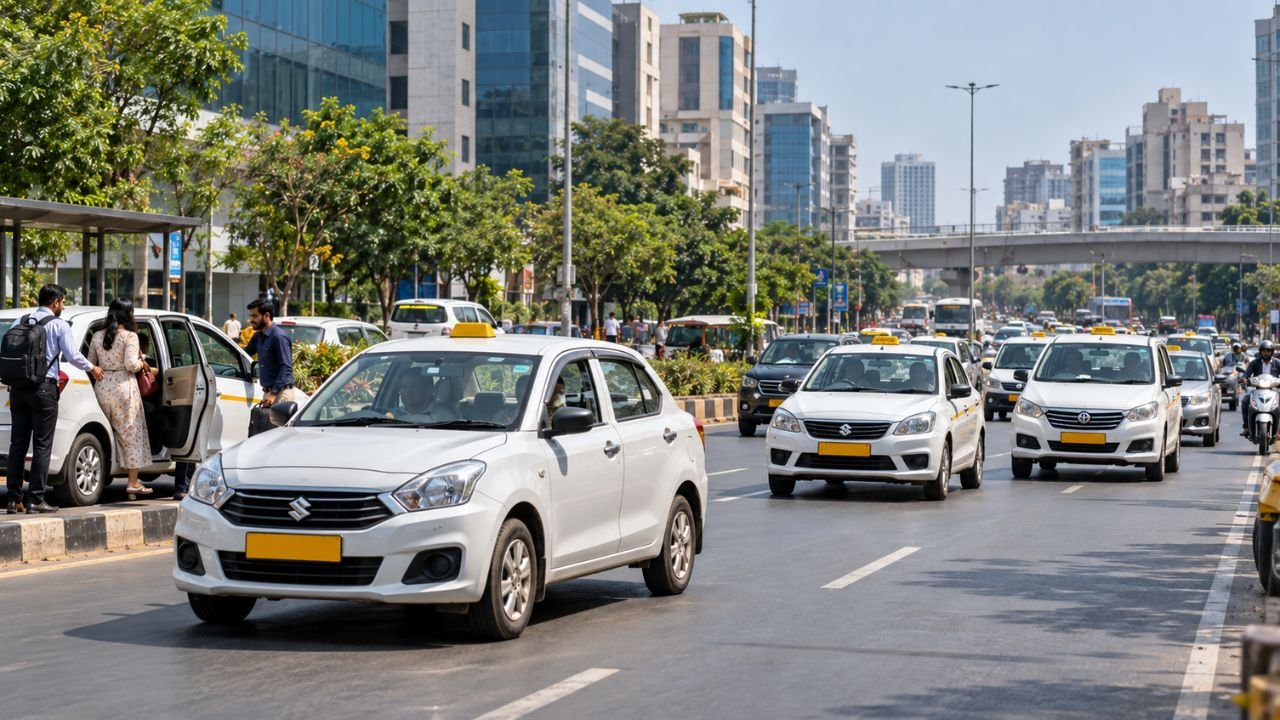
Gujarat is working on changes to its taxi and cab service system in 2026, with a focus on fare standardisation, commercial vehicle rules and clearer billing. A key part of the plan is the formation of a taxi fare committee that will work on a standard minimum and maximum fare structure. The policy discussion also covers action against private vehicles with white number plates being used for paid passenger services and the expansion of the cooperative based Bharat Taxi model. For passengers, the most important point is that the fare figures currently seen in the market should not automatically be treated as a final statewide government fixed taxi fare. The fare committee is expected to work on the standardised structure, and until that structure is officially notified, the market rates remain benchmarks rather than final rules.
Gujarat Taxi Fare Policy 2026: Key Points
The main areas covered by the 2026 taxi policy changes include:
- Formation of an official taxi fare committee
- Standardised minimum and maximum fares
- Action against private white plate vehicles used commercially
- Expansion of Bharat Taxi
- Greater standardisation of taxi services
- Current market fare benchmarks for different cab categories
- Peak time and night time fare rules
- Waiting charges
- GST and other statutory charges
These measures are intended to create a more structured system for taxi operators and passengers.
Taxi Fare Committee in Gujarat
One of the major developments is the proposed formation of an official taxi fare committee. The committee is expected to include representatives from driver unions and private aggregator companies. Its main task will be to work on a standardised fare system. The proposed system would establish minimum and maximum fare levels across cities. This would provide a common framework for calculating taxi fares instead of leaving prices to different operators and situations. The committee work is particularly important because taxi fares can vary depending on vehicle type, distance, time and additional charges. Once the committee finalises its recommendations, passengers and drivers will have a clearer reference point for fare calculations across Gujarat.
Why Is Gujarat Working on Standard Taxi Fares
The 2026 policy changes follow discussions involving taxi and auto rickshaw operators, transport authorities and private aggregators. One objective is to create clearer fare rules for passengers and drivers. A standardised fare structure could make it easier for passengers to understand how their final bill is calculated. At the same time, taxi operators would have a defined fare framework to follow. The exact statewide minimum and maximum fares are still part of the fare setting process described in the information. This means that the current market rates are likely to remain in use until the committee finalises and notifies the new structure.
Action Against White Plate Vehicles Used as Taxis
Another important part of the Gujarat taxi policy is action against private vehicles being used for commercial passenger services. Private vehicles generally carry white number plates. The policy information states that using such private two wheelers and four wheelers for paid passenger ride hailing services is being treated as an illegal commercial operation. The Transport Department has directed Regional Transport Offices, or RTOs, to take action against such commercial use. This means people using private vehicles for paid passenger services need to be aware of the distinction between private and properly authorised commercial vehicles.
What Is a White Plate Taxi
A white plate vehicle is a private vehicle registered for personal use. The policy information specifically addresses situations where private two wheelers or cars are being used to provide paid passenger services. The planned enforcement is aimed at stopping commercial passenger operations using such private vehicles without the required commercial authorisation. For passengers, checking the vehicle and booking details can therefore become an important part of choosing a taxi service. Opting for properly authorised commercial vehicles helps ensure that the ride meets regulatory requirements.
Bharat Taxi in Gujarat
Another major part of the 2026 transport policy is the expansion of Bharat Taxi, which uses a cooperative based model. Under the model described in the information, drivers are part of a driver owned cooperative rather than operating only as partners of a traditional private aggregator. The model follows the principle of Sarathi Hi Maalik, meaning drivers have an ownership role in the cooperative. A key feature is the zero commission model, under which drivers retain their earnings through the cooperative structure.
How Bharat Taxi Fits Into Gujarat Taxi System
The policy information describes Bharat Taxi as an important part of the changing taxi service structure in Gujarat. The model is intended to provide a different operating structure from the standard corporate aggregator model. The state has also signed agreements with transport related organisations and public transport bodies to support the development of a more connected taxi service network. The information specifically mentions:
- Gujarat Metro Rail Corporation
- Railway divisions
- Municipal airports
- Ahmedabad
- Surat
- Rajkot
The aim is to support regulated and transparent passenger travel.
Current Taxi Fare Benchmarks in Gujarat 2026
While the fare committee works on the broader standardised fare structure, the information lists current market benchmarks for major cities such as Ahmedabad and Surat. These figures should be understood as market running rate benchmarks, not necessarily as final statewide government fixed fares.
| Vehicle Category | Average Price Per Kilometer | Typical Fare Rule |
|---|---|---|
| Hatchback Cabs | ₹12 to ₹14 per km | 10 to 20 percent peak time surcharge |
| Sedan Cabs | ₹13 to ₹18 per km | 20 to 25 percent night surcharge |
| SUV Cabs | ₹14 to ₹22 per km | Waiting charge after first 5 minutes |
The figures can help readers understand the fare ranges mentioned in the 2026 market information.
Hatchback Taxi Fare
The listed market benchmark for hatchback cabs is around ₹12 to ₹14 per kilometre. A peak time surcharge of around 10 percent to 20 percent is mentioned for:
- 8 AM to 11 AM
- 6 PM to 9 PM
This means the final fare during these periods can be higher than the normal distance based amount. Passengers travelling during peak hours should factor in this surcharge when estimating their total ride cost.
Sedan Taxi Fare
The listed market benchmark for sedan cabs, including vehicles such as Dzire type cars, is around ₹13 to ₹18 per kilometre. A night surcharge of approximately 20 percent to 25 percent is mentioned for the period between 11 PM and 5 AM. Passengers should therefore check the fare details before confirming a ride during these hours. Late night travellers may find that the final fare is noticeably higher than the daytime rate.
SUV Taxi Fare
SUV cabs have a listed market benchmark of approximately ₹14 to ₹22 per kilometre. The information also mentions a waiting charge structure in which the first five minutes are free, followed by a waiting charge of around ₹2 to ₹3 per minute. Waiting charges can therefore increase the final bill if a vehicle remains stopped for an extended period. Passengers who anticipate delays should keep this in mind when booking an SUV.
Is the ₹12 to ₹22 Taxi Fare Official
The listed ₹12 to ₹22 per kilometre figures are described as current market fare benchmarks. They should not be confused with a final statewide fare ceiling or floor established by the proposed fare committee. The committee is intended to work on a standardised minimum and maximum fare structure. Therefore, passengers and drivers should distinguish between existing market rates and any final fare structure officially notified by the authorities. Until an official notification is issued, the market benchmarks remain the practical reference for fare calculations.
Taxi Fare Increase in Gujarat
The information also mentions a recent ₹2 to ₹3 per kilometre increase in fares across the state. The stated reasons include higher:
- Fuel costs
- Vehicle maintenance costs
- Toll plaza costs
This increase is presented as part of current market conditions while the broader fare structure is being worked out.
Gujarat Taxi GST Rules 2026
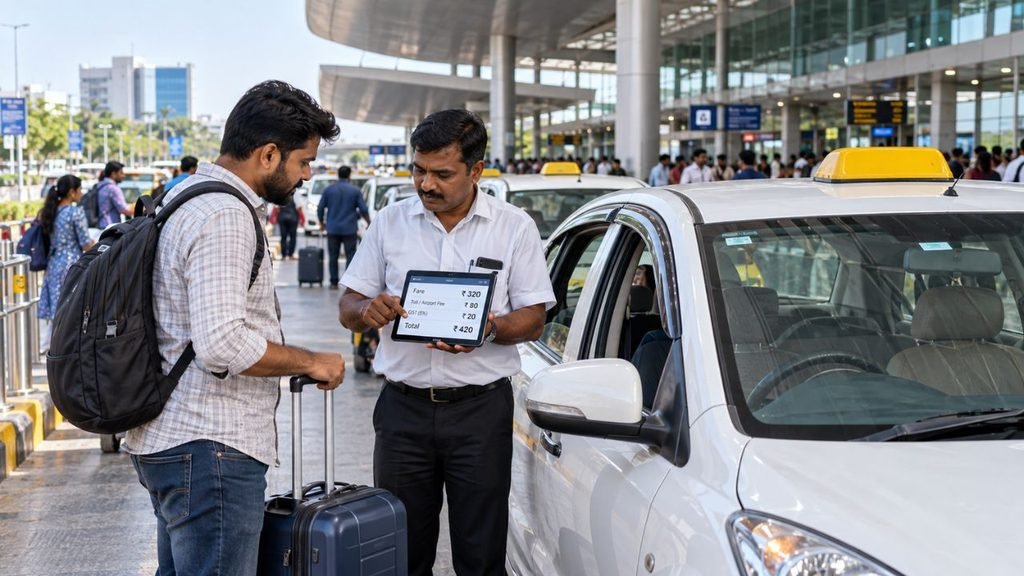
The information lists a 5 percent GST rate for air conditioned private cab services and aggregators under the described 2026 transport framework. The GST is included in the final ride fare summary. At the same time, the information states that non AC local taxis remain exempt from GST. For passengers, this means the final bill may include tax depending on the type of taxi service being used. Checking whether GST is included in the displayed fare can help passengers avoid confusion at the time of payment.
Other Charges That May Appear on a Taxi Bill
Taxi passengers may also encounter statutory charges in addition to the basic distance fare. The information lists:
- State border taxes
- Airport entry fees
- Highway tolls
These charges are billed separately on top of the calculated distance fare. Therefore, the distance based fare alone may not always represent the complete amount payable for a journey. Passengers travelling on routes involving tolls or airport entry should expect these additional charges in their final bill.
How Taxi Fare Can Be Calculated
A simple way to understand a taxi bill is to separate it into different components.
- Basic distance fare: Distance travelled multiplied by the applicable per kilometre rate
- Possible additional charges: Peak time surcharge, night surcharge or waiting charges, depending on the journey
- Statutory charges: Applicable tolls, airport entry fees or state border taxes
- GST: Applicable GST depending on the type of taxi service
The final amount can therefore be different from simply multiplying the distance by the per kilometre rate. Understanding each component helps passengers verify their bill and avoid unexpected charges.
What Taxi Passengers Should Check Before Booking
Passengers can avoid confusion by checking the fare details before starting a trip. Important points include:
- Check the vehicle category
- Check the per kilometre rate
- Look for peak time or night time surcharges
- Check whether waiting charges apply
- Check whether tolls or airport fees are additional
- Check whether GST is included in the displayed fare
- Review the final fare summary before completing payment
This is especially useful for longer journeys, airport trips and rides during peak or night hours.
What the New Taxi Framework Means for Drivers
The proposed fare standardisation can also affect taxi drivers. A clearly defined fare structure can give drivers a reference point for calculating charges. The policy information also places attention on authorised commercial vehicles and action against private vehicles being used for paid passenger services. At the same time, Bharat Taxi introduces a cooperative based model in which drivers have an ownership role and operate under a zero commission structure. The final impact on drivers will depend on how the fare committee structure and other regulatory measures are implemented.
Ahmedabad and Surat Taxi Fares
Ahmedabad and Surat are specifically mentioned among the major cities where the listed market fare benchmarks apply. The broad ranges mentioned are:
- Hatchback: ₹12 to ₹14 per km
- Sedan: ₹13 to ₹18 per km
- SUV: ₹14 to ₹22 per km
However, the final cost of a journey can change because of peak hour charges, night charges, waiting time, tolls, airport fees and applicable taxes.
Gujarat Taxi Policy 2026: What Is Changing
The major changes can be understood in four simple areas.
- Fare Standardisation: A committee is being formed to work on minimum and maximum taxi fares
- Commercial Vehicle Enforcement: RTOs are being directed to take action against private white plate vehicles being used commercially for passenger services
- Cooperative Taxi Model: Bharat Taxi is being integrated into the state changing mobility system through a driver owned cooperative approach
- Clearer Billing: The framework discusses distance fares, surcharges, waiting charges, GST and statutory charges so that different parts of a taxi bill can be identified
Important Difference Between Market Rates and Final Government Fares
This is an important point for both passengers and drivers. The fare figures such as ₹12 to ₹14 per kilometre for hatchbacks and ₹14 to ₹22 per kilometre for SUVs are presented as current market benchmarks. The official fare committee is separately working on a standardised minimum and maximum fare structure. Therefore, these numbers should not be presented as the final statewide taxi fares unless and until the applicable fare structure is officially finalised and notified.
Gujarat Taxi Fare Policy 2026: Quick Summary
| Topic | Details |
|---|---|
| Fare Committee | Proposed for standardised taxi fares |
| Committee Members | Driver unions and private aggregators |
| White Plate Commercial Use | Action by RTOs |
| Bharat Taxi | Cooperative based taxi model |
| Hatchback Benchmark | ₹12 to ₹14 per km |
| Sedan Benchmark | ₹13 to ₹18 per km |
| SUV Benchmark | ₹14 to ₹22 per km |
| Peak Surcharge | 10 to 20 percent for listed peak periods |
| Night Surcharge | 20 to 25 percent for listed night period |
| Waiting | First 5 minutes free, then ₹2 to ₹3 per minute |
| AC Cab GST | 5 percent as stated in the information |
| Non AC Local Taxi | GST exempt as stated |
| Other Charges | Tolls, airport fees and state border taxes |
Conclusion
Gujarat Taxi Fare Policy 2026 is moving toward a more structured fare system with the proposed formation of a taxi fare committee, standardised minimum and maximum fares, action against private white plate vehicles used commercially and the expansion of the Bharat Taxi cooperative model. The current market benchmarks for hatchback, sedan and SUV cabs range between ₹12 and ₹22 per kilometre, with peak time surcharges, night surcharges and waiting charges applicable under different conditions. A 5 percent GST applies to AC cab services, while non AC local taxis remain exempt. Passengers should check the vehicle category, per kilometre rate, surcharges and additional charges before booking a ride, and remember that the market rates will remain benchmarks until the fare committee officially notifies the final structure.
Frequently Asked Questions
Q1. What is the Gujarat Taxi Fare Policy 2026?
A1. The policy focuses on fare standardisation, commercial vehicle enforcement, expansion of Bharat Taxi and clearer billing through a proposed taxi fare committee.
Q2. What is the current taxi fare benchmark in Gujarat?
A2. The market benchmarks are ₹12 to ₹14 per km for hatchbacks, ₹13 to ₹18 per km for sedans and ₹14 to ₹22 per km for SUVs.
Q3. What is Bharat Taxi in Gujarat?
A3. Bharat Taxi is a cooperative based taxi model where drivers have ownership in the cooperative and operate under a zero commission structure following the Sarathi Hi Maalik principle.
Q4. What action is being taken against white plate taxis?
A4. The Transport Department has directed RTOs to take action against private white plate vehicles being used for paid passenger services without commercial authorisation.
Q5. What GST applies to taxi services in Gujarat?
A5. A 5 percent GST applies to AC private cab services and aggregators, while non AC local taxis remain exempt from GST as stated in the information.