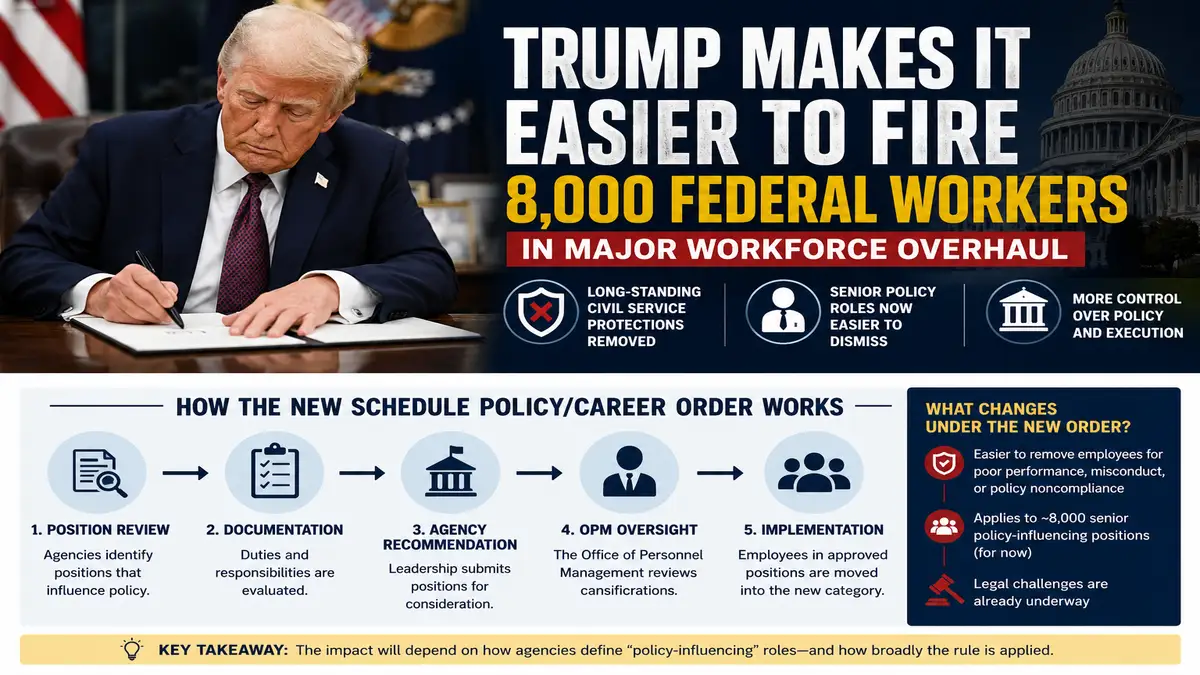
Trump federal workers firing initiative is drawing national attention, but one of the most overlooked aspects of the executive order is how the government determines which federal positions qualify for Schedule Policy/Career status.
Many people assume the White House directly selects employees for reclassification. However, agencies generally evaluate positions rather than individuals. The review focuses on whether a role influences policy development, regulatory decisions, grant distribution, or key executive priorities.
How the Classification Process Typically Works
| Step | What Happens |
|---|---|
| Position Review | Agencies identify jobs involved in policy-making activities |
| Documentation | Duties and responsibilities are evaluated |
| Agency Recommendation | Leadership submits positions for consideration |
| OPM Oversight | The Office of Personnel Management reviews classifications |
| Implementation | Employees in approved positions are moved into the new category |
Why Similar Employees May Be Treated Differently
A policy analyst who drafts regulations may face reclassification, while another analyst performing technical research may remain under traditional civil service protections.
This distinction could become one of the most contested areas of implementation as agencies interpret what qualifies as “policy-influencing” work.
The Hidden Reality
The long-term impact of the executive order may depend less on the number of employees affected today and more on how broadly agencies define policy-related positions in the future.
Accountability vs Independence: The Debate Is More Complicated Than It Appears
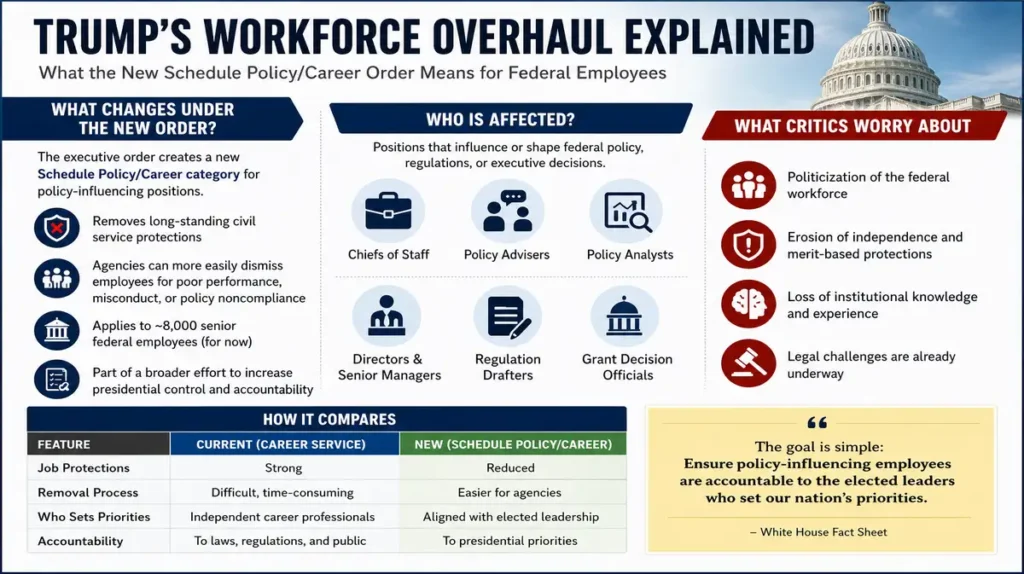
Public discussion around the executive order often presents the issue as a simple political battle. In reality, both supporters and critics raise legitimate concerns.
Situations Where Easier Removal Could Help
| Potential Benefit | Explanation |
| Faster policy implementation | Agencies can align more quickly with elected leadership |
| Performance management | Underperforming senior officials can be removed more efficiently |
| Increased responsiveness | Leadership may gain greater control over agency priorities |
| Reduced bureaucratic resistance | Policy changes may face fewer internal obstacles |
Situations Where Easier Removal Could Create Risks
| Potential Risk | Explanation |
| Political pressure | Employees may feel pressure to align with political preferences |
| Expertise loss | Experienced staff may leave government service |
| Reduced independence | Professional judgment could be influenced by job security concerns |
| Institutional disruption | Frequent turnover may slow long-term projects |
Why This Matters
Government agencies are expected to achieve two goals that sometimes conflict with each other:
- Carry out the policies of elected leaders.
- Maintain professional independence and expertise.
The challenge is finding the right balance between those objectives.
Myth vs Reality: Common Misconceptions About Trump’s Federal Workforce Order
As debate over the executive order grows, several misconceptions have emerged.
| Myth | Reality |
| All federal employees are affected | Only a small portion of the federal workforce is currently included |
| Employees can now be fired for any reason | Federal laws and constitutional protections still apply |
| This immediately impacts 50,000 workers | Current estimates focus on roughly 8,000 positions |
| Every policy employee is a political appointee | Many affected workers are career civil servants |
| Civil service protections disappear entirely | Certain procedural and legal safeguards remain available |
Why These Distinctions Matter
Understanding the difference between political appointees and career employees is essential because many of the positions under discussion have historically been filled by nonpartisan professionals who serve under multiple administrations.
The Overlooked Risk: Losing Institutional Knowledge
One concern receiving relatively little attention is the possibility of losing institutional knowledge inside federal agencies.
What Is Institutional Knowledge?
Institutional knowledge refers to the expertise accumulated by employees who have spent years or even decades working within an agency.
This includes:
- Understanding complex regulations
- Managing long-term programs
- Maintaining relationships with stakeholders
- Navigating legal requirements
- Preserving historical context behind policy decisions
Why It Matters
When experienced officials leave, agencies may lose valuable information that cannot easily be replaced through hiring.
Historical Lessons
Large-scale workforce changes in both government and private organizations have often produced unintended consequences, including:
- Delays in program implementation
- Training challenges
- Reduced operational efficiency
- Increased compliance risks
Supporters argue that fresh leadership can improve accountability. Critics counter that excessive turnover can weaken organizational effectiveness.
The reality may depend on how agencies manage workforce transitions over time.
Which Federal Roles Could Face Future Reclassification?
Although the latest executive order affects approximately 8,000 employees, observers continue to debate how broadly the policy could expand.
Higher-Risk Positions
These roles are more likely to be viewed as policy-influencing:
- Policy advisers
- Regulatory drafters
- Chiefs of staff
- Strategic planning directors
- Senior management officials
- Grant allocation decision-makers
Moderate-Risk Positions
These employees may face review depending on agency responsibilities:
- Program managers
- Supervisory personnel
- Budget planners
- Operations leadership teams
Lower-Risk Positions
These positions generally focus on technical expertise rather than policy development:
- Scientists
- Engineers
- Medical professionals
- Researchers
- Administrative support staff
- Technical specialists
Important Caveat
Future classifications will likely depend more on job duties than job titles. Two employees with identical titles could face different outcomes depending on the responsibilities assigned to their positions.
What Courts Will Actually Examine During Legal Challenges
Several unions and advocacy groups have already challenged the policy in court. However, the legal questions may be more complex than many headlines suggest.
Key Questions Judges May Consider
1. Does the Executive Branch Have Authority to Reclassify These Positions?
Courts may examine whether existing federal laws provide sufficient authority for the changes.
2. How Broad Is the Definition of Policy-Making Work?
One of the most important legal issues could involve determining which employees genuinely influence policy.
3. Were Proper Administrative Procedures Followed?
Judges may evaluate whether agencies and regulators complied with required rulemaking processes.
4. Are Career Civil Service Protections Being Undermined?
Opponents argue that the changes weaken long-standing protections designed to keep government service nonpartisan.
Why the Outcome May Not Be Simple
Legal experts note that courts do not always fully uphold or fully reject major administrative policies. Instead, judges sometimes allow portions of a rule to remain while blocking specific applications.
As a result, the final impact of Trump’s executive order may ultimately depend not only on politics but also on how courts interpret federal employment law in the years ahead.