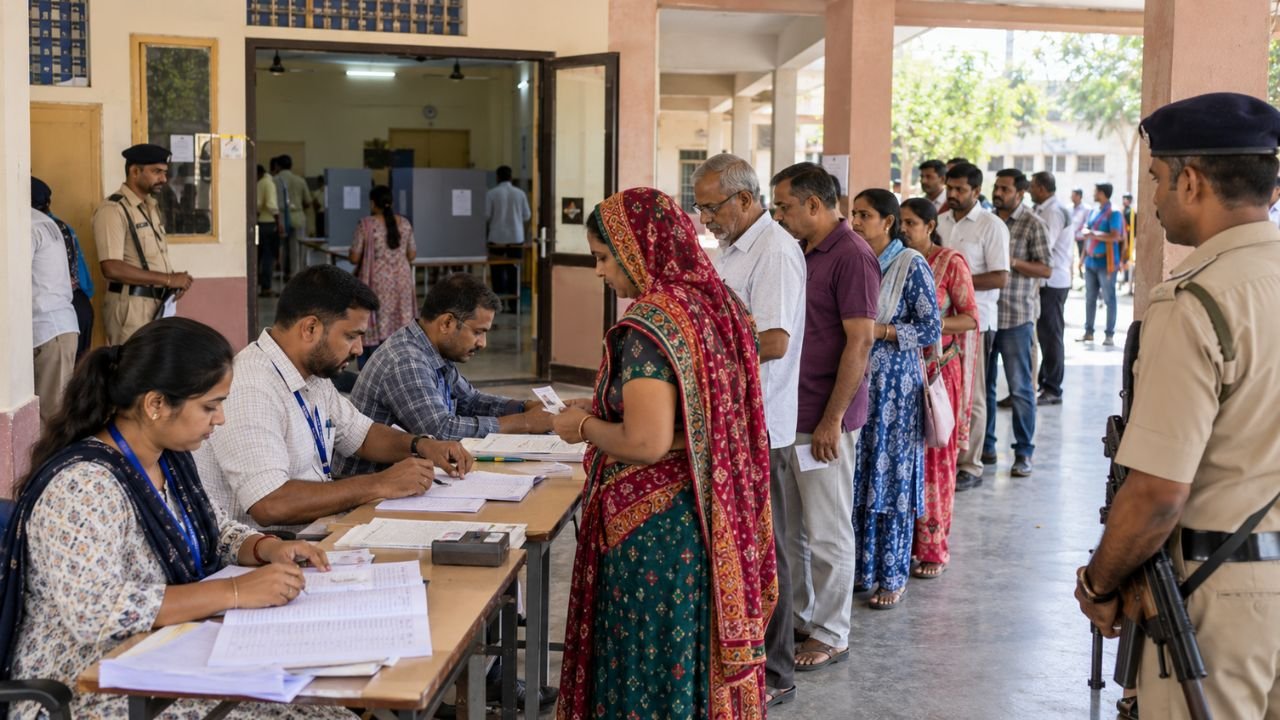
The Gandhinagar Municipal Corporation Election 2026 is a major local political contest in Gujarat’s state capital. The election features a three-cornered contest involving the Bharatiya Janata Party (BJP), the Indian National Congress and the Aam Aadmi Party (AAP). The polling process is being managed by the State Election Commission (SEC) under security arrangements designed to ensure a peaceful election. The contest covers 44 seats across 11 wards, with each ward electing a four-member panel. A total of 2,59,780 eligible voters are included in the electoral statistics, while 130 candidates are contesting the election. The major parties have presented different development priorities, including urban transformation, property tax relief and greater transparency in local administration.
Gandhinagar Municipal Corporation Election 2026: Key Statistics
The election includes several important figures and arrangements that give a clear picture of the scale of the contest. Half of the 44 seats are reserved for women, which is a significant detail in this election. To manage the voting process smoothly, around 1,130 police personnel and 1,700 polling staff have been deployed across the city. Of the 295 polling booths, 90 have been classified as sensitive, which means extra security arrangements have been made at these locations.
| Election Detail | Information |
|---|---|
| Total Eligible Voters | 2,59,780 |
| Male Voters | 1,32,457 |
| Female Voters | 1,27,314 |
| Total Seats | 44 |
| Total Wards | 11 |
| Seats Reserved for Women | 22 |
| Total Candidates | 130 |
| Polling Stations | 295 |
| Sensitive Polling Stations | 90 |
| Police Personnel Deployed | Around 1,130 |
| Polling Staff Deployed | 1,700 |
| Polling Date | Sunday, October 11, 2026 |
| Polling Hours | 7:00 AM to 6:00 PM |
| Counting and Results | Tuesday, October 13, 2026 |
GMC Election 2026: Candidates and Political Parties
A total of 130 candidates are contesting the Gandhinagar Municipal Corporation Election 2026. The BJP and Congress have each fielded a full panel of 44 candidates, while AAP is contesting with 32 candidates. The remaining 10 candidates include one candidate from the Bahujan Samaj Party (BSP) and nine independent candidates. This mix shows that while the main fight is between the three major parties, independents and smaller parties are also trying their luck in the contest.
BJP Candidates
The Bharatiya Janata Party has fielded 44 candidates across the 11 wards. Its campaign highlights the party’s previous administrative record and a development vision focused on transforming Gandhinagar into a “Sports Capital and GenZ City.” The BJP’s stated ambition also includes moving Gandhinagar beyond its traditional identity as the “City of the Secretariat” and developing it into a global conference hub. The party is banking on its recent performance in local body elections and its development narrative to retain control of the civic body.
Congress Candidates
The Indian National Congress has also fielded 44 candidates. Its campaign focuses on resident relief, transparency and property tax reductions. Under its “Congress na Commitment” manifesto, the party has promised a 25% reduction in residential property tax and a 10% reduction in commercial property tax. Congress is positioning itself as the party that will bring financial relief to residents and businesses if elected.
AAP Candidates
The Aam Aadmi Party has fielded 32 candidates. Although the party originally had more valid nominations, five candidates withdrew before the deadline, leaving AAP short of a full panel across all wards. This means AAP will not be able to contest every seat, which could affect its overall chances in the election.
Independent Candidates and BSP
The remaining 10 candidates consist of one BSP candidate and nine independent candidates. Ward No. 6 has the highest concentration of candidates, with 15 contesting candidates. Ward No. 1 has the lowest number, with 10 candidates. This uneven distribution shows that some wards have more intense competition than others.
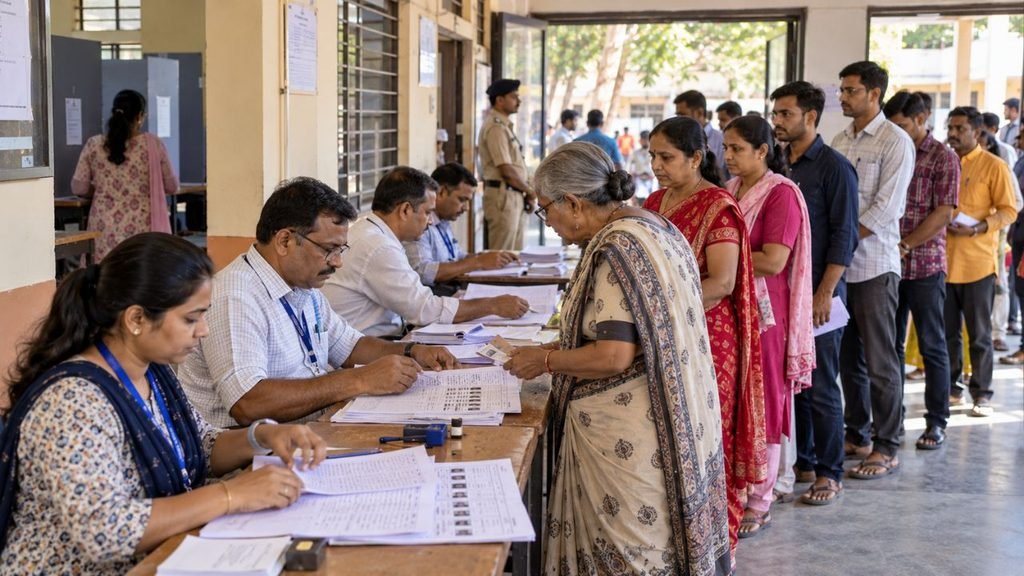
What Are the Main Issues in the Gandhinagar Election?
The political contest is centred on different approaches to municipal development, administration and financial relief for residents. The BJP is promoting its vision of developing Gandhinagar as a sports and youth-focused city, while also seeking to expand its role as a conference destination. Congress is placing greater emphasis on reducing property taxes and improving transparency through its manifesto commitments. These contrasting priorities make the election an important contest for the three major parties as they seek to demonstrate their organisational strength and support among local voters. For residents, the key questions are about better civic amenities, lower taxes and transparent local governance.
Political Background of the Gandhinagar Municipal Corporation
The Gandhinagar Municipal Corporation has a history of closely contested local elections. Since its establishment in 2010, control of the civic body has shifted due to narrow majorities and political defections. Congress won the first election in 2011, while the second election resulted in a tie. In the last full election, held in October 2021, the BJP secured a landslide majority by winning 41 of the 44 seats. Congress won two seats, while AAP made its debut with one seat. Subsequent political defections left AAP’s lone councillor as the distinct opposition voice. The 2026 election is another opportunity for the major parties to assess their grassroots organisational strength ahead of the 2027 Gujarat Legislative Assembly elections.
Gandhinagar Municipal Corporation Election 2026: Important Dates
Voters and candidates should note the following election schedule:
- Polling Day: Sunday, October 11, 2026, from 7:00 AM to 6:00 PM
- Counting and Results: Tuesday, October 13, 2026
The election covers 11 wards and 44 seats, with security personnel and polling staff deployed across the 295 polling booths. Voters are advised to carry a valid photo ID and check their polling station details in advance to avoid last-minute confusion.
Conclusion
The Gandhinagar Municipal Corporation Election 2026 features 130 candidates from the BJP, Congress, AAP, BSP and independent groups competing for 44 seats across 11 wards. With 2,59,780 eligible voters, the election is an important local political contest for Gujarat’s capital. The BJP is highlighting its development plans for Gandhinagar, while Congress is focusing on property tax relief and transparency. AAP is also contesting, although it has fielded fewer candidates than the BJP and Congress. Polling is scheduled for October 11, 2026, with counting and results set for October 13, 2026. The outcome will not only decide who controls the civic body but also give an indication of the political mood in Gujarat ahead of the 2027 Assembly elections.
Frequently Asked Questions
Q1. When is the Gandhinagar Municipal Corporation Election 2026 being held?
A1. Polling is scheduled for Sunday, October 11, 2026, from 7:00 AM to 6:00 PM, with counting and results on Tuesday, October 13, 2026.
Q2. How many seats and wards are there in the GMC Election 2026?
A2. The election covers 44 seats across 11 wards, with each ward electing a four-member panel. Half of the seats, 22 in total, are reserved for women.
Q3. How many candidates are contesting the Gandhinagar Municipal Corporation Election 2026?
A3. A total of 130 candidates are contesting. The BJP and Congress have each fielded 44 candidates, AAP has fielded 32, and the remaining 10 include one BSP candidate and nine independents.
Q4. What are the main issues in the Gandhinagar election?
A4. The BJP is focusing on developing Gandhinagar as a sports and youth-focused city and a global conference hub, while Congress is promising a 25% reduction in residential property tax and a 10% reduction in commercial property tax under its manifesto.
Q5. What is the political history of the Gandhinagar Municipal Corporation?
A5. Since its establishment in 2010, Congress won the first election in 2011, the second election ended in a tie, and in the 2021 election, the BJP won 41 of 44 seats, Congress won two and AAP won one seat.