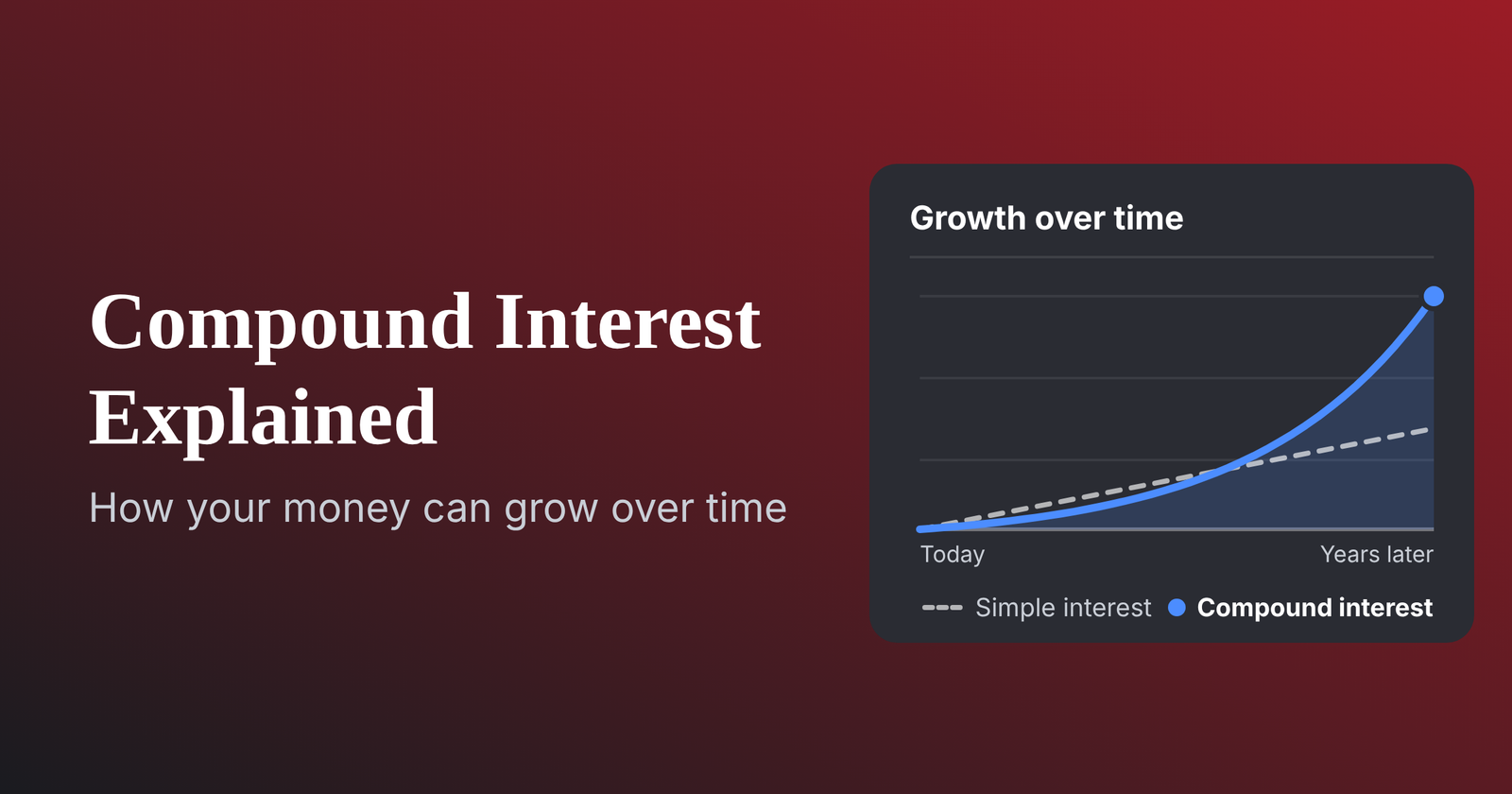
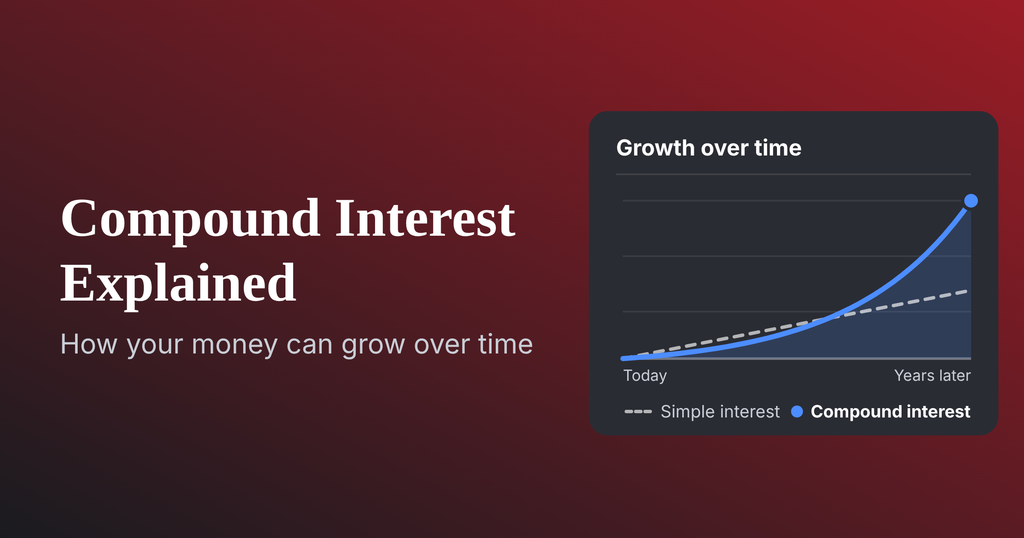
Compound interest explained in one idea: it is interest that earns interest. Instead of growing in a straight line, your money grows faster and faster, because each round of growth becomes part of the base for the next. Over short periods the effect is small. Over many years, it can be surprisingly large.
This compound interest explained guide walks you through how it works, the formula, a quick shortcut called the Rule of 72, real examples with numbers, and seven practical ways to put it to work. It also covers the other side of the coin, because compound interest can grow debt just as quickly. The maths applies worldwide, and we flag where rules or products vary by country. This article is general education, not personalised financial advice.
Table of Contents
- Compound interest explained: the basics
- Simple vs compound interest
- The compound interest formula
- How compounding frequency matters
- The Rule of 72: a quick shortcut
- Why starting early matters so much
- 7 ways to make compound interest work for you
- When compound interest works against you
- Common mistakes to avoid
- Worldwide advice vs. country-specific rules
- Frequently asked questions
- Conclusion
Compound Interest Explained: The Basics
Compound interest explained simply: when you save or invest money, you can earn interest on your original amount, called the principal. With compounding, you also earn interest on the interest you have already received. Each time interest is added, your balance gets bigger, so the next round of interest is calculated on a larger amount.
The U.S. Securities and Exchange Commission’s investor education site explains this idea in its guide, What is compound interest?, which also introduces the Rule of 72 as a way to estimate how long money takes to double.
Think of a snowball rolling downhill. It starts small, but as it picks up more snow, it grows faster. Compound interest works in a similar way, and time is the hill.
Simple vs Compound Interest
Simple interest is calculated only on your original principal. Compound interest is calculated on the principal plus all the interest added so far.
Here is a hypothetical example. Suppose you put 1,000 in an account paying 5% a year, and you never add or withdraw anything:
| Years | Balance with simple interest | Balance with compound interest (annual) |
|---|---|---|
| 10 | 1,500 | about 1,629 |
| 20 | 2,000 | about 2,653 |
| 30 | 2,500 | about 4,322 |
In the first few years, the difference is small. But the gap widens every year. After 30 years, compounding has added far more than simple interest would. That is compound interest explained in numbers: the growth builds on itself.
The Compound Interest Formula
You do not need to be a maths expert, but the formula helps you understand what is happening. Here is the compound interest explained as an equation:
A = P × (1 + r ÷ n) ^ (n × t)
- A is the final amount
- P is the starting amount (principal)
- r is the annual interest rate, written as a decimal (5% is 0.05)
- n is how many times interest is compounded each year
- t is the number of years
For example, 1,000 at 5% compounded annually for 10 years is 1,000 × (1.05)^10, which is about 1,629. The SEC offers a free compound interest calculator if you would like to test your own numbers without doing the maths by hand.
How Compounding Frequency Matters
Interest can be added annually, quarterly, monthly or even daily. The more often it compounds, the more you earn, though the difference is usually modest. Here is a hypothetical comparison for 10,000 at 5% a year over 10 years:
| Compounding | Balance after 10 years |
|---|---|
| Annually | about 16,289 |
| Monthly | about 16,470 |
| Daily | about 16,487 |
Compound interest explained further: the biggest drivers of growth are the rate, the amount and above all the time. Frequency is a smaller factor. When comparing savings accounts, look at the APY (annual percentage yield) in the US, or the equivalent measure in your country, such as AER in the UK. These figures include the effect of compounding, so they make accounts easier to compare.
The Rule of 72: A Quick Shortcut
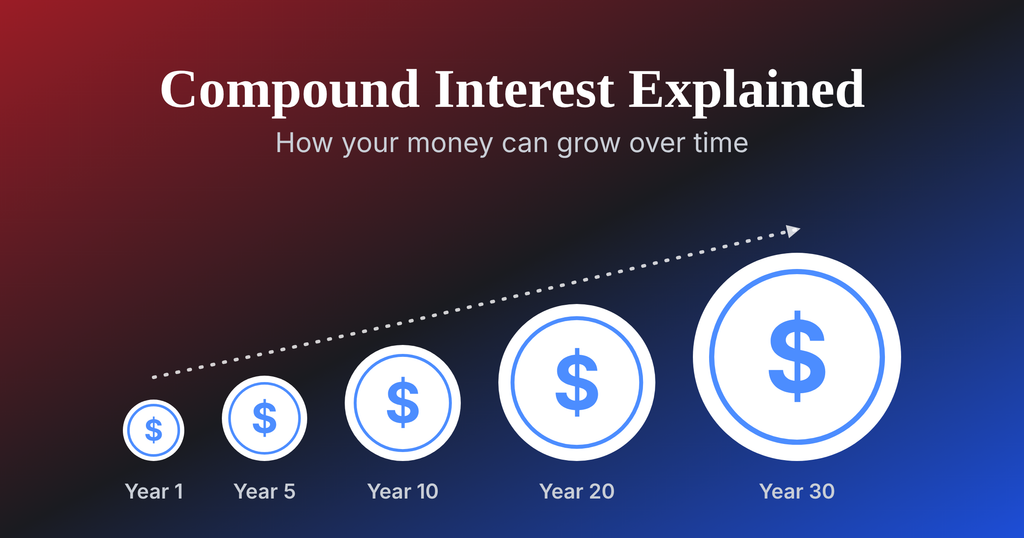
A useful trick in any compound interest explained guide is the Rule of 72. Divide 72 by the annual interest rate to estimate how many years it will take for your money to double. The St. Louis Fed uses this rule in its article on how compound interest works, and notes that it is an approximation.
| Annual rate | Approximate years to double |
|---|---|
| 3% | 24 years |
| 4% | 18 years |
| 6% | 12 years |
| 8% | 9 years |
The Rule of 72 assumes a steady rate, which real investments rarely deliver. Use it for a rough sense of scale, not a forecast.
Why Starting Early Matters So Much
Time is the secret behind compound interest explained. Starting early gives your money more rounds of compounding. Here is a hypothetical example. Assume a steady 6% annual return, compounded monthly:
- Alex invests 100 a month for 10 years, then stops adding money but leaves the balance invested for another 30 years.
- Blake waits 10 years, then invests 100 a month for 30 years.
| Total contributed | Balance after 40 years | |
|---|---|---|
| Alex (starts early, 10 years of saving) | 12,000 | about 98,700 |
| Blake (starts late, 30 years of saving) | 36,000 | about 100,450 |
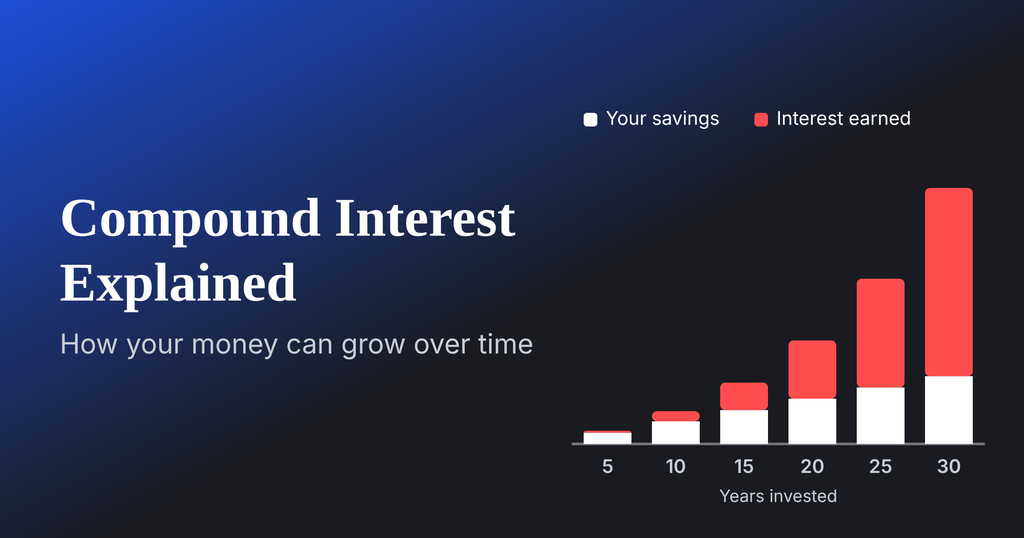
Alex puts in only a third as much money, but ends up with nearly the same amount, because those early deposits had decades to grow. This is a simplified illustration with a constant return. Real returns vary, can be negative and are never guaranteed, and the figures ignore fees, taxes and inflation. The lesson is that even small, early contributions matter.
7 Ways to Make Compound Interest Work for You
1. Start as Early as You Can
Even small amounts benefit from long time horizons. If you are only able to save a little right now, begin anyway. Our guide on how to save money on a low income shows how to start with small amounts.
2. Save or Invest Regularly
Regular contributions create a stream of new money that also compounds. Set up an automatic transfer on payday so you do not have to rely on willpower. Our guide on how to create a monthly budget helps you find an amount you can sustain.
3. Choose Accounts That Pay Interest
Money in a non-interest account does not compound. Compare savings accounts for their APY, fees and conditions, and keep emergency money somewhere safe and accessible. Our guide to checking account vs savings account explains how to choose.
4. Reinvest Your Earnings
Compounding works best when you leave earnings in the account or reinvest them, instead of withdrawing them. Many savings and investment accounts have options to reinvest automatically.
5. Keep Fees Low
Fees reduce your balance and compound the wrong way. A small yearly fee can take a surprising bite out of your growth over decades. Always check account fees, fund costs and any charges for withdrawals.
6. Be Patient and Avoid Unnecessary Withdrawals
Every time you withdraw money, you reduce the base that compounds. Keep long-term money separate from everyday spending, and avoid dipping into it for non-emergencies.
7. Use Time-Tested Tools and Be Realistic
Compound interest explained for investments is slightly different, because returns from shares or funds are not fixed and can fall as well as rise. The compounding effect can still work over long periods, but it comes with risk. Use regulated providers, diversify and consider your timeframe. Money you need within a few years usually belongs in safer places.
When Compound Interest Works Against You
Compound interest explained would be incomplete without debt. The same snowball that helps savings can grow what you owe. Here is a hypothetical example. If you owe 1,000 on a card charging 20% a year, compounded monthly, and you make no payments for 5 years, the balance would grow to about 2,696.
This is why high-interest debt is so costly, and why paying more than the minimum matters. Our guide to good debt vs bad debt explains how to tell helpful borrowing from harmful borrowing, and our guide on what is a personal loan shows how a loan’s interest and APR add up.
Common Mistakes to Avoid
- Waiting for a “big enough” amount. Time matters more than the starting size, so begin with what you can.
- Ignoring fees. Fees compound against you, so compare costs carefully.
- Chasing high returns without understanding risk. If an offer promises guaranteed high returns, treat it as a warning sign.
- Withdrawing too early. Frequent withdrawals interrupt compounding.
- Forgetting inflation and tax. Interest earned may be taxed, and rising prices reduce what your money can buy.
- Using the Rule of 72 as a promise. It is only a rough estimate.
- Carrying expensive debt while saving small amounts. In many cases, paying down high-interest debt first gives a better result. Freeing up cash by trimming spending can help, so see our list of everyday expenses you can cut.
- Treating compounding as a shortcut. It rewards consistency over many years, not quick wins.
For a broader plan that ties saving, spending and borrowing together, read our guide on how to manage your money better.
Worldwide Advice vs. Country-Specific Rules
The maths behind compound interest explained here is universal. A balance that earns interest on interest grows the same way in any currency. But several details depend on your country:
- Interest rates and products: Savings rates, deposit schemes and investment options vary widely.
- Rate measures: The US uses APY and APR, while other countries use terms such as AER or effective annual rate.
- Tax treatment: Interest and investment gains may be taxed differently, and some countries offer tax-free or tax-deferred accounts.
- Deposit protection: Compensation limits and schemes differ.
- Regulation and fees: Who regulates providers and which charges are allowed depend on local law.
Check your national regulator or tax authority for official guidance, and consider a qualified local adviser for complex decisions. Please also read our Disclaimer for more detail.
Frequently Asked Questions
Can you give compound interest explained in simple words?
Yes. Compound interest is interest you earn on your original money plus the interest you have already earned. Because each round of interest gets added to your balance, the next round is calculated on a bigger amount, so your money grows faster over time.
What is the easiest compound interest explained example?
Imagine you put 1,000 in an account that pays 5% a year. After one year you have 1,050. In the second year, you earn 5% on 1,050, not on 1,000, which gives you 1,102.50. That small extra amount is the effect of compounding, and it grows larger each year.
What is the difference between APR and APY?
APR is the annual rate without the effect of compounding within the year. APY includes compounding, so it shows what you would earn in a year. When comparing savings accounts, APY gives a clearer picture. Different countries use different names, so check the definitions your provider uses.
Does compound interest apply to stocks and investments?
The idea of growth building on growth applies, because reinvested returns can earn further returns. However, shares and funds do not pay a fixed rate, their value can fall, and results are not guaranteed. Understand the risks and use regulated providers.
How long does it take to double my money?
You can estimate with the Rule of 72: divide 72 by the annual rate. At 6%, doubling takes about 12 years. It is only an approximation and assumes a steady rate, which real investments rarely provide.
Is it ever too late to benefit from compound interest?
No. Starting earlier is better, but any time you save or invest, your money has some time to compound. Regular contributions, low fees and patience still help, even if you begin later in life.
Conclusion
Compound interest explained comes down to three ingredients: your money, the rate it earns and time. Of these, time is the one most people underestimate. Small, regular amounts left to grow for many years can add up, while high-interest debt left alone can grow just as fast in the wrong direction.
Start where you are. Set up an automatic transfer, choose an account or investment with low fees, avoid unnecessary withdrawals and be patient. Review your progress once or twice a year. With compound interest explained and in your corner, the most powerful step is simply the first one.