
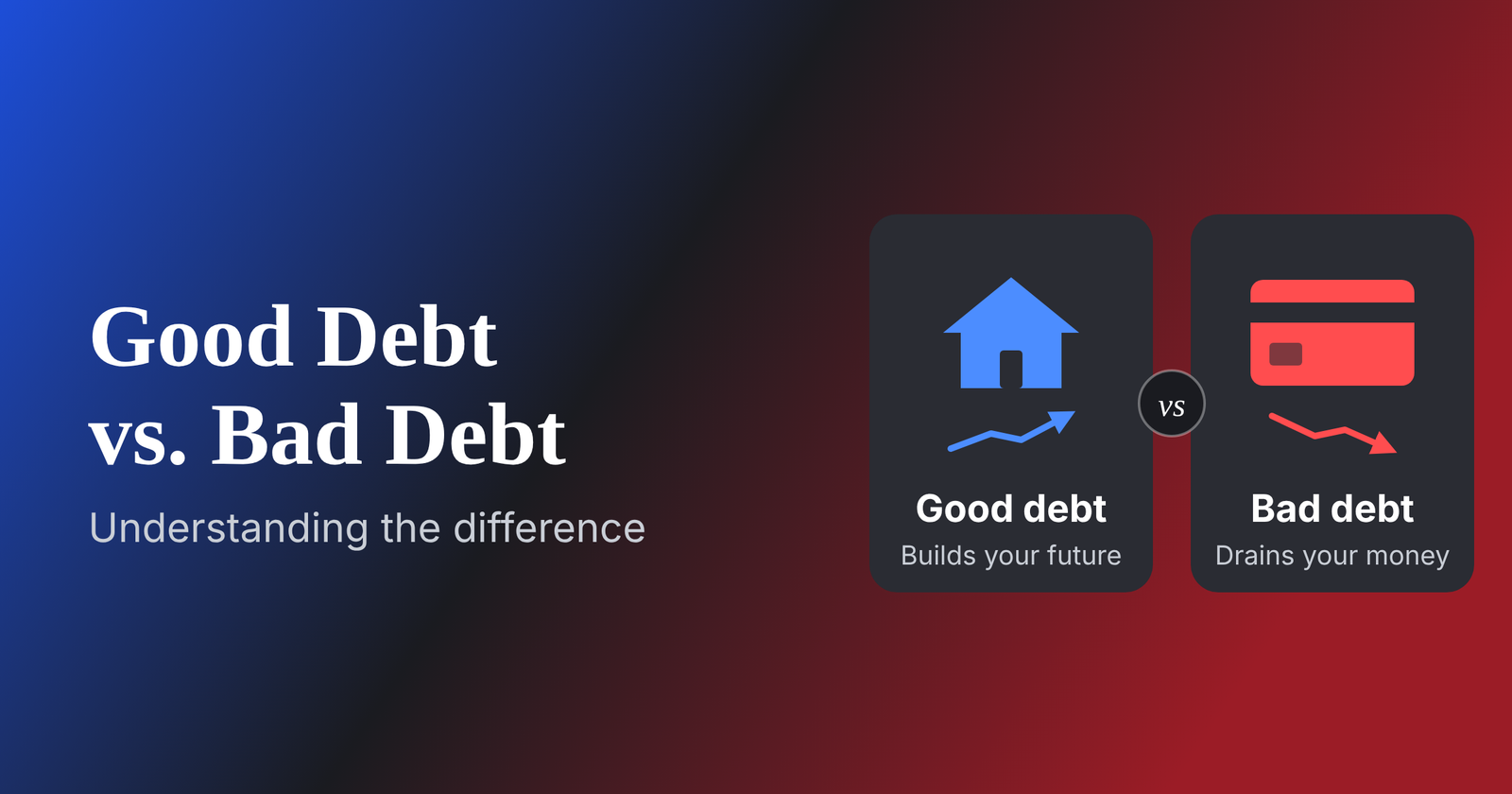
A good debt vs bad debt. Few money topics cause as much confusion as debt. Some people say all debt is dangerous. Others say it is a tool every wealthy person uses. The truth sits in the middle, and understanding good debt vs bad debt can help you borrow with more confidence and avoid costly mistakes.
This guide explains what separates good debt vs bad debt, gives clear examples, shows the real cost of expensive borrowing and offers a simple five-question test you can use before you borrow. The core ideas apply worldwide, and we flag where rules depend on your country. This article is general education, not personalised financial advice.
Table of Contents
- Good debt vs bad debt: a quick definition
- 7 key differences at a glance
- What is good debt?
- What is bad debt?
- The gray area: when good debt turns bad
- 5 questions to ask before you borrow
- Debt-to-income ratio: a simple health check
- A worked example: the real cost of bad debt
- How to handle the debt you already have
- Common mistakes to avoid
- Worldwide advice vs. country-specific rules
- Frequently asked questions
- Conclusion
Good Debt vs Bad Debt: A Quick Definition
In everyday finance, good debt is borrowing that is likely to improve your financial position over time, at a cost you can afford. Bad debt is borrowing for things that lose value or give you only short-term enjoyment, often at a high interest rate that makes repayment hard.
The good debt vs bad debt label is a helpful shortcut, not a legal category. No lender uses these terms, and the same loan can be helpful for one person and harmful for another. What matters is the purpose of the loan, its cost, how well it fits your budget and what happens if things go wrong.
7 Key Differences at a Glance
| Factor | Good debt | Bad debt |
|---|---|---|
| Purpose | Builds long-term value, income or stability | Pays for short-term wants or consumption |
| Cost | Usually a reasonable, fixed rate | Often a high rate, sometimes with heavy fees |
| Value over time | The asset or skill may grow or hold value | The item often loses value, or is used up |
| Affordability | Payments fit comfortably in your budget | Payments strain your budget or rely on more borrowing |
| Risk | Manageable, with a clear repayment plan | Easy to fall behind, with penalties and compounding interest |
| Effect on credit | On-time payments can support your credit history | Missed payments and high balances can damage your credit |
| Examples | Sensible mortgage, well-chosen education loan, affordable business loan | Card balances carried month to month, payday loans, overspending on credit |
Use this table as a guide, not a rule. A loan that looks like good debt can turn bad if the amount is too large, and a small, short-term borrowing sometimes makes sense in a genuine emergency.
What Is Good Debt?
Good debt is borrowing with a purpose that can improve your financial future. Typical examples include:
- A mortgage. Buying a home can build equity over time and may be cheaper than renting long term in some places. But prices can fall, and ownership costs are real, so it is not guaranteed.
- Education loans. Learning that increases your skills and earning power can justify borrowing. The value depends on the course, the cost, your likely income and the loan terms.
- A small business loan. Borrowing to start or grow a viable business can create income, though many businesses struggle, so the risk is real.
- A well-priced loan for something essential. For example, a reasonably priced loan for a reliable vehicle you need to get to work could be sensible if it fits your budget.
In the good debt vs bad debt discussion, notice what these examples have in common. Each is tied to a clear purpose, has a manageable repayment plan, and has the potential to create value or protect your ability to earn. Even then, the word “good” is conditional. Always check the interest rate, fees and what you could lose if you cannot repay.
What Is Bad Debt?
Bad debt typically funds consumption, carries a high cost and offers little or no lasting value. Common examples include:
- Credit card balances carried month to month. Card interest can be expensive, and balances grow quickly when you only make minimum payments.
- Payday loans and similar high-cost short-term loans. Their charges can be very high and can trap borrowers in repeat borrowing.
- Store cards and “buy now, pay later” overuse. Small instalments feel painless, but several at once can overload a budget, and late fees can be steep.
- Borrowing for luxury purchases. Using debt to pay for holidays, gadgets or fashion you cannot afford leaves you paying long after the enjoyment has faded.
- Debt used to cover regular living costs. If you borrow every month to get by, the debt is a warning sign that your budget needs attention.
The U.S. Consumer Financial Protection Bureau notes that APR is the interest rate plus additional fees, which makes it a better way to compare the cost of borrowing than the interest rate alone. When a loan’s APR is high, the debt can quickly move into bad debt territory, no matter what you borrowed it for.
The Gray Area: When Good Debt Turns Bad
The good debt vs bad debt line is not always clear. Here are common ways that “good” borrowing goes wrong:
- Borrowing too much for education. If the loan is large compared with your likely income, repayments can become a heavy burden.
- Buying a home you can barely afford. A mortgage that uses most of your income leaves no room for repairs, rising costs or job loss.
- Using a business loan for a weak plan. A loan cannot fix a business idea that does not make money.
- Taking a car loan that is too long or too large. A vehicle usually loses value, so a big, long loan can leave you owing more than the car is worth.
- Consolidating debt, then running up the old balances again. A consolidation loan can be a smart move, but only if you stop adding new debt. Our guide to what is a personal loan explains how these loans work and what to check before you sign.
The reverse can also be true. A small, short-term borrowing from a low-cost source to repair a car you need for work may be better than losing your job. Context matters more than labels.
5 Questions to Ask Before You Borrow
When you are deciding between good debt vs bad debt, run any loan through these five questions:
- What is this debt for? Will it build value, protect your income or meet a real need, or does it fund a want?
- What does it really cost? Compare the APR, fees and total repayment amount, not just the monthly payment.
- Can I afford it? Check the payment against a realistic budget. Our guide on how to create a monthly budget shows how to find a safe amount.
- What happens if things go wrong? Consider job loss, illness or rising costs. Do you have savings or a backup plan? Is any asset at risk?
- Is there a cheaper or safer alternative? Could you save up, wait, borrow less or use a lower-cost option?
If you cannot answer these questions clearly, pause before you borrow. A day or two of research is cheap compared with years of repayments.
Debt-to-Income Ratio: A Simple Health Check
Lenders often look at your debt-to-income ratio (DTI), which compares your monthly debt payments with your gross monthly income. The CFPB explains that a debt-to-income ratio is one way lenders measure your ability to manage the payments you make every month to repay money you have borrowed.
You can calculate your own:
- Add up your monthly debt payments, such as rent or mortgage, loans and minimum card payments.
- Divide that total by your gross (before-tax) monthly income.
- Multiply by 100 to get a percentage.
For example, if your monthly debt payments total 1,200 and your gross monthly income is 4,000, your DTI is 1,200 ÷ 4,000 = 0.30, or 30%. A lower ratio generally means more breathing room. There is no single perfect number, and lenders and countries use different thresholds. Treat your DTI as a warning light: if it keeps rising, debt may be taking over your budget.
A Worked Example: The Real Cost of Bad Debt
To see how expensive carrying a card balance can be, look at this hypothetical example. Suppose you owe 3,000 on a credit card with a 20% annual interest rate, and you make no new purchases.
| Fixed monthly payment | Time to pay off | Approximate interest paid |
|---|---|---|
| 100 | about 42 months | about 1,190 |
| 200 | about 18 months | about 480 |
Doubling the payment cuts the payoff time by more than half and saves roughly 700 in interest. These figures are simple estimates based on constant monthly payments and a fixed rate. Real cards may change rates, charge fees or require different minimum payments. The point is that expensive debt grows quietly, and paying more than the minimum has a powerful effect.
How to Handle the Debt You Already Have
If you already carry debt, you can improve your position with a clear plan:
- List every debt. Write down the balance, interest rate, minimum payment and due date.
- Pay at least the minimum on everything. Missed payments cause fees and damage your credit.
- Target the most expensive debt first. Many people use the “avalanche” method, which directs extra payments to the highest interest rate. Others prefer the “snowball” method, which clears the smallest balance first for motivation. Either works if you stick with it.
- Free up cash. Look for savings in your spending. Our list of everyday expenses you can cut is a good place to start.
- Build a small emergency fund. Without one, new surprises can push you back into debt. If money is tight, see our guide to saving money on a low income.
- Protect your credit. On-time payments and low card balances support your score. Our guide on how to improve your credit score explains how, and the US government’s credit score guide covers the basics.
- Ask for help early. If you cannot keep up, contact your lender about hardship options, and look for free non-profit or government-approved credit counselling in your country.
For a wider view of how debt fits into your finances, read our guide on how to manage your money better. If you want to automate repayments and keep spending separate, our guide to checking account vs savings account explains how to organise your accounts.
Common Mistakes to Avoid
- Treating all debt as evil, or all debt as smart. The good debt vs bad debt question depends on cost, purpose and affordability.
- Paying only the minimum on high-interest balances. This keeps you in debt for much longer.
- Focusing only on the monthly payment. A lower payment may just mean a longer loan and more interest.
- Borrowing to fund regular spending. This is a sign that the budget needs fixing first.
- Ignoring fees and penalties. Late fees, prepayment penalties and origination fees change the true cost.
- Co-signing without understanding the risk. If the borrower misses payments, you are responsible.
- Falling for debt relief or loan scams. Be wary of upfront fees, guaranteed approval and unsolicited offers.
- Taking on new debt before building a safety net. Without savings, one surprise can trigger a spiral.
Worldwide Advice vs. Country-Specific Rules
The principles behind good debt vs bad debt apply almost everywhere: borrow for a purpose, know the true cost, keep payments affordable and avoid expensive debt. But many details depend on your country:
- Interest rate limits and lending rules: Some countries cap rates or restrict certain products. Others do not.
- Mortgage and education loan systems: Terms, tax treatment, public support and repayment rules vary widely.
- Credit reporting: How debts affect your credit history differs by country.
- Insolvency and debt relief rules: Your rights if you cannot repay depend on local law.
- Consumer protection: Regulators, complaint processes and disclosure rules are national.
For decisions involving large loans, legal rights or insolvency, use official government sources or a qualified local adviser. Please also read our Disclaimer for more detail.
Frequently Asked Questions
What is the main difference between good debt vs bad debt?
The main difference in good debt vs bad debt is purpose and cost. Good debt helps build long-term value or income at an affordable cost. Bad debt funds short-term wants, usually at a high cost, and it can be hard to repay.
Is a mortgage always good debt?
No. A mortgage can build equity and provide stable housing, but it can become a burden if the payments are too high, prices fall or your income drops. Check affordability carefully and keep a buffer for repairs and rising costs.
Are student loans good debt?
They can be, if the education is likely to improve your earning power and the loan amount is reasonable compared with your expected income. Borrowing a large sum for a course with uncertain job prospects can be risky.
Is credit card debt always bad debt?
Carrying a balance on a high-interest card is usually bad debt. Using a card and paying the full statement balance on time is different, because you avoid interest. If you must carry a balance, aim to pay it down quickly.
Should I pay off debt or save first?
For most people, the best approach is to do both in stages. Build a small emergency fund first so a surprise bill does not force more borrowing. Then pay down high-interest debt aggressively while making at least minimum payments on everything else.
Is it ever smart to take on bad debt?
Sometimes people borrow in an emergency, such as to repair a car they need for work. Even then, compare lower-cost options first. If you do borrow, choose the cheapest source available and make a clear plan to repay it quickly. Understanding good debt vs bad debt helps you make the least costly choice when your options are limited.
Conclusion
The good debt vs bad debt distinction is useful because it makes you ask better questions. What is this borrowing for? What will it really cost? Can I afford it? What happens if my situation changes? A loan that builds value at a fair price and fits your budget is very different from an expensive balance that grows while you pay for something you no longer use.
Start by listing your current debts, checking their interest rates and focusing on the most expensive ones first. Before you take on anything new, run it through the five-question test in this guide. Over time, you will spend less on interest, protect your credit and keep more of your income working for you. Knowing good debt vs bad debt will not remove all risk, but it will help you borrow with your eyes open.