Understanding fixed vs variable interest rates is one of the most useful skills you can build before taking out a loan, a mortgage or any other form of credit. The type of rate you choose can change your monthly payment, your total cost and how much stress a loan puts on your budget.
This guide explains fixed vs variable interest rates in plain language, including how each one works, where the real trade-offs are and how to decide. The advice applies worldwide, but products, benchmarks and consumer rules differ by country, so we flag those differences as we go. This article is general education, not personal financial, legal or tax advice, and it is not a recommendation to borrow.
Table of Contents
- What Are Fixed vs Variable Interest Rates?
- How a Fixed Interest Rate Works
- How a Variable Interest Rate Works
- Fixed vs Variable Interest Rates: Side-by-Side Comparison
- Worked Example: Fixed vs Variable Interest Rates in Numbers
- 7 Tips for Choosing Between Fixed and Variable Rates
- Common Mistakes to Avoid
- Worldwide Advice vs. Country-Specific Rules
- Frequently Asked Questions
- Conclusion
What Are Fixed vs Variable Interest Rates?
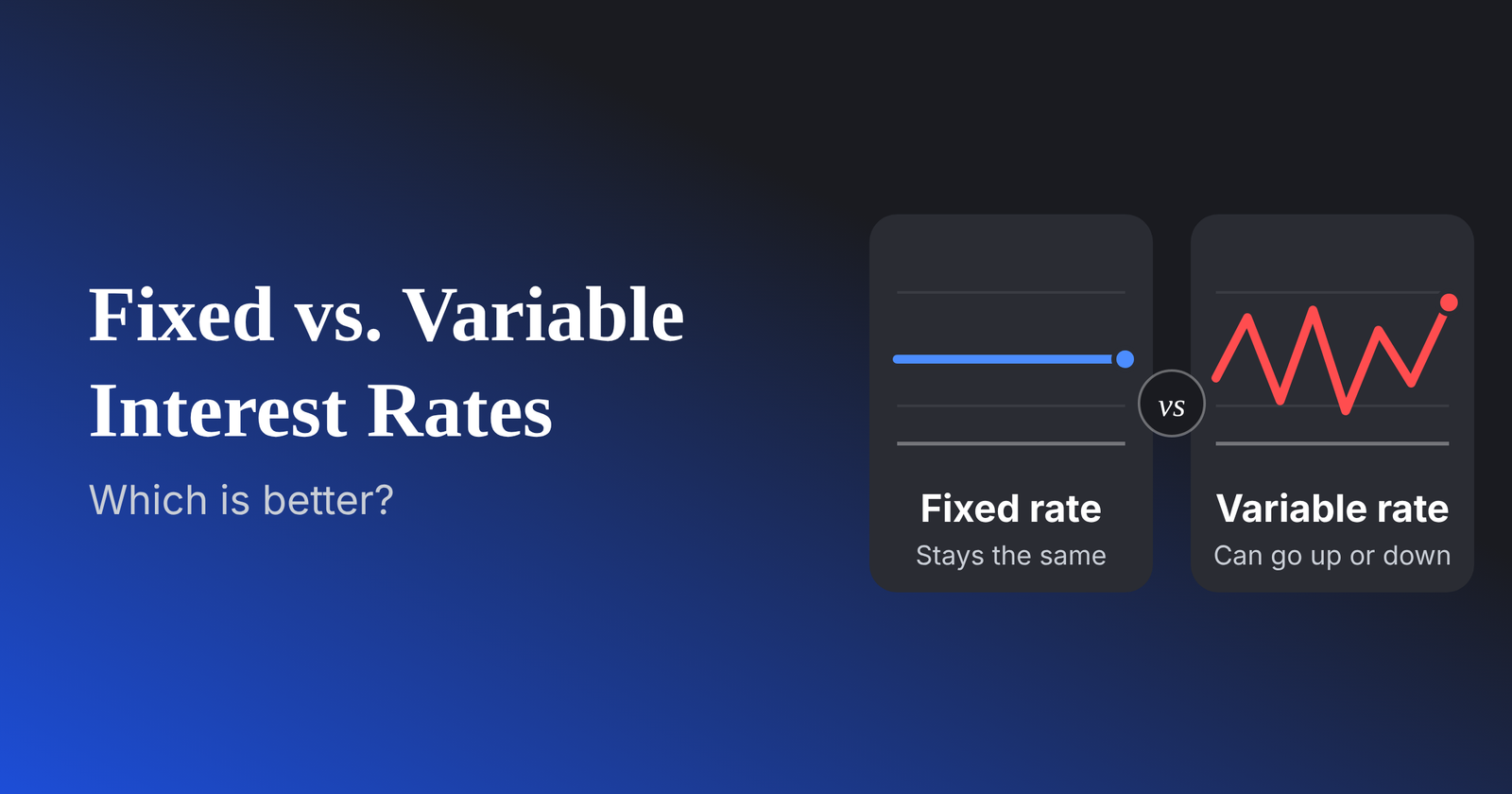
Interest is the price of borrowing money. A fixed rate is set when you take out the loan and stays the same for an agreed period. A variable rate (also called an adjustable or floating rate) can rise or fall while you are repaying the loan.
The difference matters because interest builds on what you still owe. If you want a refresher on that process, see our guide to compound interest.
Why the Choice Between Fixed vs Variable Interest Rates Matters
Your rate type decides how predictable your payments are and how exposed you are to changes in the wider economy. It can apply to many products, including mortgages, student loans, business loans and credit cards. If you are new to borrowing, our explainer on what is a personal loan shows how a typical loan works. Card balances are often charged at variable rates, which is one reason it helps to pay off credit card debt faster.
Rate type can also matter for savings products, where a variable rate may rise or fall with the market. This article focuses on borrowing. In short, fixed vs variable interest rates is a choice between certainty and flexibility.
How a Fixed Interest Rate Works
When comparing fixed vs variable interest rates, the fixed option is usually the simpler one to understand. With a fixed rate, the rate stays the same for the fixed period. If the fixed period covers the whole loan, your payment of principal and interest will not change because of rate movements. Some loans are fixed only for an initial period, such as a few years, and then move to another rate. Always check what happens when the fixed period ends.
Possible advantages:
- Predictable payments make budgeting easier.
- You are protected from rate rises during the fixed period.
- It can give peace of mind on a long loan.
Possible drawbacks:
- The starting rate is often higher than a comparable variable rate, although not always.
- If market rates fall, you may not benefit unless you switch or refinance.
- Leaving a fixed deal early can trigger early repayment charges in some countries.
How a Variable Interest Rate Works
A variable rate moves over time. On many loans it is linked to a benchmark or index, with the lender adding a margin on top. The US Consumer Financial Protection Bureau explains that, on an adjustable-rate mortgage, part of the rate is tied to a broader measure of interest rates called an index. It adds that many such loans start at a lower rate than fixed-rate loans, and that some have caps limiting how far the rate can rise.
On other products, the lender may set the rate itself and can change it according to the contract. The principle is the same: your cost can go up or down. In the fixed vs variable interest rates debate, a variable loan usually leaves more of the risk with you.
Possible advantages:
- The starting rate is often lower, which can mean lower early payments.
- You may benefit if market rates fall.
- Some variable loans allow early repayment with fewer penalties, though this varies.
Possible drawbacks:
- Payments can rise, sometimes sharply, which is often called payment shock.
- Budgeting is harder because the future cost is unknown.
- A loan that is affordable today may become a strain if rates climb.
Fixed vs Variable Interest Rates: Side-by-Side Comparison
The table below summarises fixed vs variable interest rates at a glance.
| Feature | Fixed rate | Variable rate |
|---|---|---|
| Rate behaviour | Stays the same for the fixed period | Can rise or fall over time |
| Payment predictability | High | Lower |
| Starting rate | Often higher | Often lower, but not always |
| If market rates fall | You may miss out unless you switch | You may benefit |
| If market rates rise | Protected during the fixed period | You are exposed |
| Early repayment | May carry charges | Varies by product |
| Often suits | Tight budgets and long loans | Borrowers with spare budget room and a short horizon |
A fixed rate may suit you if you want stable payments, your budget has little slack or you plan to keep the loan for a long time.
A variable rate may suit you if you can absorb higher payments, you expect to repay the loan early or you value the chance of lower costs if market rates fall. Neither description is advice; it only shows how people often think about the trade-off.
Hybrid and Capped Options
Some loans mix the two approaches. A hybrid loan has a fixed rate for a set number of years and then becomes variable. Others keep a variable rate but add caps that limit how much it can change. These options can reduce risk, but they add complexity, so read the reset terms closely and ask what the worst-case payment would be.
Worked Example: Fixed vs Variable Interest Rates in Numbers
The figures below are hypothetical and for illustration only. Suppose you borrow 20,000 over 5 years (60 monthly payments). Option A is a fixed rate of 8% for the whole loan. Option B is a variable rate that starts at 6% for the first 24 months and then changes for the remaining 36 months. All rates are made up. Payments are recalculated when the rate changes so the loan still ends on schedule. This is how many repayment loans work, but your own contract may handle rate changes differently, for example by changing the loan term instead.
| Scenario | Payment, first 24 months | Payment, last 36 months | Total interest | Total repaid |
|---|---|---|---|---|
| Fixed at 8% | 405.53 | 405.53 | 4,332 | 24,332 |
| Variable, falls to 4.5% | 386.66 | 378.08 | 2,891 | 22,891 |
| Variable, rises to 9% | 386.66 | 404.17 | 3,830 | 23,830 |
| Variable, rises to 12% | 386.66 | 422.15 | 4,477 | 24,477 |
In three of the four scenarios the variable option costs less, partly because of its lower starting rate. In the last scenario, it costs about 145 more than the fixed loan (4,477 − 4,332), and the monthly payment jumps by about 35 (422.15 − 386.66).
That is why fixed vs variable interest rates should be judged on risk as well as cost. The lesson is not that one option always wins. The better question is whether you could comfortably afford the worst case. Figures are rounded, and real loans may use different calculation methods and fees.
7 Tips for Choosing Between Fixed and Variable Rates
- Stress-test your budget. Ask the lender for the highest payment your loan could reach, then check whether you could afford it. Our guide on how to create a monthly budget can help.
- Value certainty if money is tight. If a payment rise would cause real hardship, predictability may be worth a higher starting rate.
- Think about your time horizon. Short loans, or loans you plan to repay early, may suit different rate types than long ones. Check any early repayment charges.
- Compare total cost, not just the headline rate. The CFPB notes that an interest rate does not reflect fees or other charges, while APR includes some of them. It also warns that APRs of adjustable-rate loans do not reflect the maximum rate, so take care when comparing fixed vs variable interest rates.
- Understand caps and timing. Find out how often a variable rate can change, how it is calculated and whether there are limits.
- Keep a buffer. An emergency fund helps you absorb higher payments. Our guide on how to manage your money better covers the basics.
- Work on your credit profile. In many countries, a stronger credit history can lead to better offers. See how to improve your credit score.
Common Mistakes to Avoid
These errors most often catch out people comparing fixed vs variable interest rates for the first time:
- Choosing variable only for the low starting rate. A cheap start can become costly if the rate rises.
- Ignoring the maximum payment. Caps and limits matter as much as the starting figure.
- Assuming fixed is always safe. It may cost more, may carry exit charges and may revert to a different rate after the fixed period.
- Forgetting fees. Compare the full cost, not only the interest rate.
- Trying to predict rates. Nobody can reliably forecast them. Plan for several outcomes instead.
- Borrowing at the limit of affordability. Whatever the rate type, leave room in your budget. Our explainer on good debt vs bad debt can help you judge whether a loan is worth taking.
Worldwide Advice vs. Country-Specific Rules
Some principles of fixed vs variable interest rates hold almost everywhere. Others depend on local markets and law.
| Worldwide principle | What varies by country |
|---|---|
| Fixed rates give predictability; variable rates give flexibility and risk | Which type is most common, and how long fixed periods usually last |
| Variable rates follow a benchmark or lender decision | Which benchmarks are used and how rate changes must be notified |
| Compare total cost, not only the rate | How APR or similar measures are calculated and disclosed |
| Check early repayment terms | Whether early repayment charges are allowed or capped |
| Stress-test your budget | Consumer protections and available debt help |
Because these rules differ, check your national regulator or consumer protection agency before you sign. Please also read our disclaimer, and speak to a regulated adviser if you need personal advice. Amounts here have no currency symbol so they can apply anywhere.
Be wary of lenders who promise a guaranteed low rate, ask for upfront fees before approving a loan, or pressure you to sign quickly. These are common warning signs of a scam.
Frequently Asked Questions
What is the main difference between fixed vs variable interest rates?
A fixed rate stays the same for an agreed period, while a variable rate can change during the loan. That affects how predictable your payments are. The right choice depends on your budget, your loan term and how much uncertainty you can handle.
Are fixed rates always more expensive than variable rates?
No. Fixed rates are often higher at the start, but not in every market or at every time. Over the whole loan, the cheaper option depends on how rates move, which nobody can predict reliably.
Which is better when interest rates are rising?
In the fixed vs variable interest rates choice, a fixed rate can protect you from rises during the fixed period, but you may start at a higher rate. A variable rate may begin lower but could increase. Compare the likely cost of each against what you could afford.
Can a fixed rate change?
Yes, in some cases. Many loans are fixed only for an initial period and then move to another rate. Read the terms to see what happens when the fixed period ends.
Can I switch between rate types?
Often you can, but it may involve fees, a new application or early repayment charges. Ask your lender about the cost and compare it with the possible savings before deciding.
How do I choose between fixed vs variable interest rates?
Start with your budget and ask whether you could afford the highest possible payment. Then compare total cost, loan term and any fees. If you are unsure, a regulated adviser or your national consumer agency can help.
Conclusion
There is no single winner in the debate over fixed vs variable interest rates. A fixed rate trades a possibly higher starting cost for certainty, while a variable rate trades certainty for a possibly lower cost and more risk.
Your next step with fixed vs variable interest rates is practical: ask any lender for the highest payment a variable loan could reach, compare it with your budget, and weigh it against the fixed option. If you can afford the worst case, a variable rate may be worth considering. If you cannot, certainty may be worth paying for.
Whatever you choose, read the full terms, compare the total cost and be wary of any promise of guaranteed savings. With a clear view of fixed vs variable interest rates, you can borrow with more confidence and fewer surprises.