
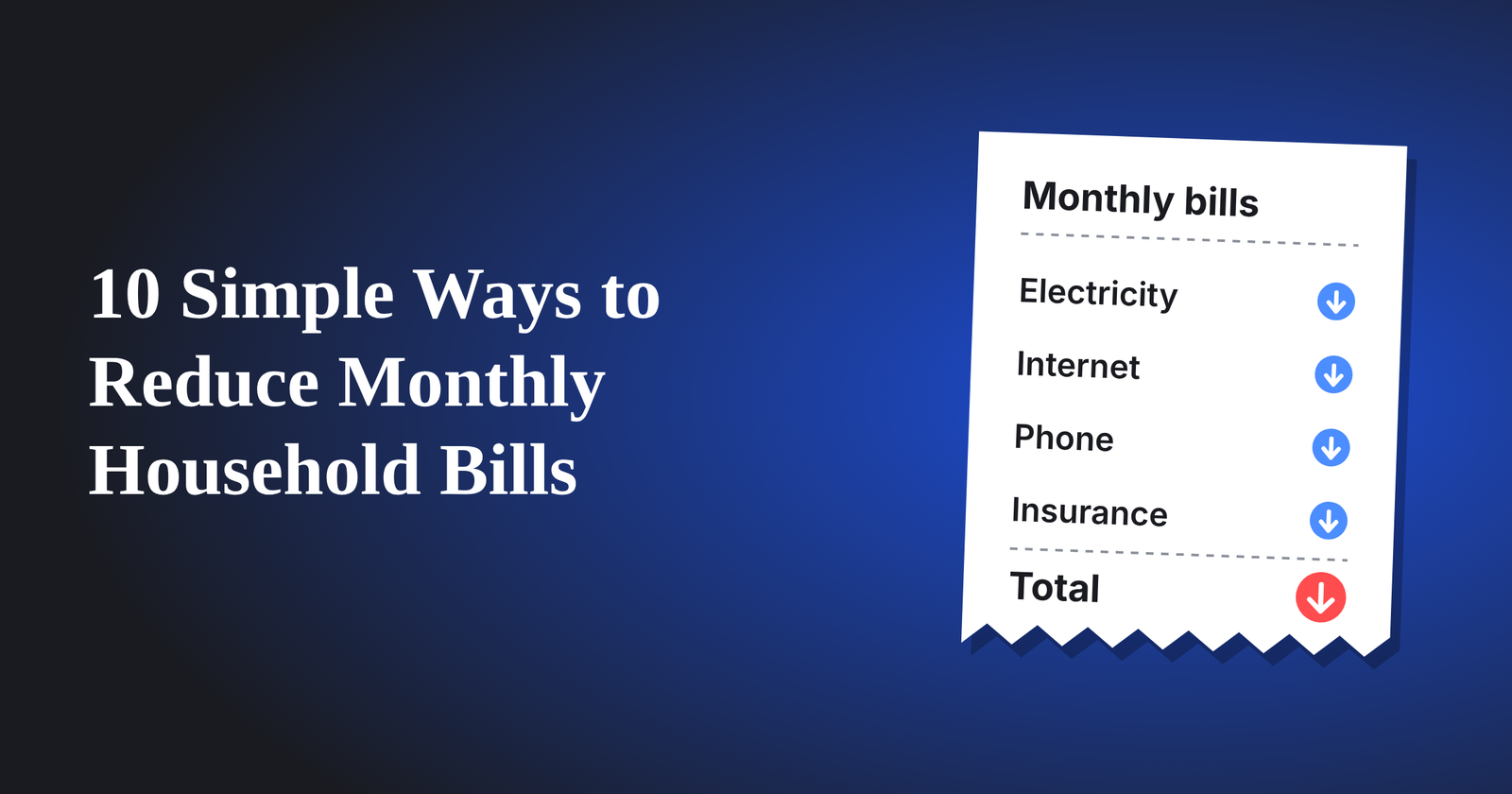
The most reliable way to reduce monthly household bills is to review them one by one, because most households overpay on at least a few of them without realising. Energy, phone, internet, insurance, subscriptions and bank charges often renew automatically, so the price quietly rises while your needs stay the same. This guide is written for readers worldwide, so it uses neutral currency amounts and flags where national rules, providers and support schemes differ. It is general education, not personal financial, legal or tax advice.
In this article you will learn ten practical ways to reduce monthly household bills, how to track your progress and what a realistic saving can look like in a hypothetical example. You will also see common mistakes and answers to six frequently asked questions. A written plan makes every tip easier to apply, so our guide on how to create a monthly budget is a useful companion.
Table of Contents
- Why It Pays to Reduce Monthly Household Bills
- Before You Start: Build a Bill Map
- 10 Ways to Reduce Monthly Household Bills
- Hypothetical Worked Example: Reduce Monthly Household Bills
- How to Keep Your Bills Low Over Time
- Common Mistakes When You Try to Reduce Monthly Household Bills
- Worldwide Advice vs. Country-Specific Rules
- Frequently Asked Questions
- Conclusion
Why It Pays to Reduce Monthly Household Bills
Bills are the part of your budget that repeats without you noticing. A saving of even a small amount on each one adds up every single month, and unlike a one-off discount it keeps working without extra effort. When you reduce monthly household bills, you free up money for emergencies, debt repayment or savings goals.
There is also a stress benefit. Moneysmart, Australia’s official consumer money site, notes that a budget gives you control over your money and less stress about bills, and it offers a planner to see where your money goes and find ways to save. The ideas below build on that same principle: know what you pay, then decide what is worth keeping.
Before You Start: Build a Bill Map
To reduce monthly household bills, you first need a clear picture of them. Spend 30 minutes on this:
- Gather the last two or three months of statements, including bank and card statements.
- List every recurring bill, with its amount, due date, contract end date and any exit fee.
- Mark which are essential (housing, utilities, basic insurance) and which are optional (extra subscriptions, premium plans).
- Circle the three biggest bills and any you do not recognise.
Many people discover forgotten subscriptions or duplicate services at this step. If your income is very tight, our guide on how to save money on a low income shows how to start with small, manageable changes.
10 Ways to Reduce Monthly Household Bills
Use the ten ways below in any order. Start with the biggest bills, where a small percentage saved is worth the most.
Way 1: Track Every Recurring Bill
Keep your bill list somewhere you will see it, such as a spreadsheet or a notes app. Add renewal dates so you can compare options before a contract rolls over. Check each new bill for unexpected increases, new fees or services you did not request.
Way 2: Cut Energy Use to Reduce Monthly Household Bills
Energy is often one of the largest household costs, and small habits can lower it:
- Adjust your thermostat slightly and heat or cool only the rooms you use.
- Seal draughts around doors and windows.
- Switch to efficient lighting.
- Turn off devices left on standby.
- Wash clothes in cold water and run full loads.
The U.S. Department of Energy notes that renters and homeowners alike can take many small steps to make a home more energy efficient and cut bills. ENERGY STAR also publishes low- and no-cost energy saving tips. Some utilities offer home energy checks, so ask yours.
Way 3: Compare Energy Suppliers and Plans
Where you can choose your supplier, compare the price per unit, any daily or fixed charges, contract length and exit fees. A plan that looks cheaper may cost more once fees apply. Use your regulator’s or government’s official comparison tool if one exists in your country.
Way 4: Use Less Water
Fix leaking taps and toilets, take shorter showers and fit efficient fixtures if you own your home. Because heating water uses energy, saving hot water lowers both your water and energy bills.
Way 5: Review Your Phone and Internet Plans
Many households pay for more data, speed or channels than they use. Moneysmart’s cost of living help page suggests comparing phone plans to find the best value for money. Check your actual usage over several months, then look at cheaper plans, prepaid options or bundles. Ask your current provider whether it can match a lower price, and read the contract length and device payment terms before switching.
Way 6: Cancel Unused Subscriptions
Streaming, apps, memberships and software add up quickly. Cancel anything you have not used in the last month, rotate services instead of keeping all of them and check whether an annual plan is genuinely cheaper than monthly billing. Our list of 15 everyday expenses you can cut has more ideas.
Way 7: Shop Around for Insurance
Compare quotes at each renewal, because the loyalty price is not always the best. Compare the cover, limits and excess, not just the price, so you do not trade savings for gaps in protection. Combining policies with one provider can sometimes lower the cost. Raise your excess only if you could comfortably afford it in a claim, and do not drop cover you genuinely need.
Way 8: Cut Bank Fees and Late Fees
Check your statements for account fees, ATM charges, overdraft costs and late payment penalties. If your account is costly, compare alternatives, as explained in our comparison of checking account vs savings account. Set reminders or automatic payments so you never pay a late fee.
Way 9: Lower the Cost of Debt
Interest is a monthly bill too. If you carry card balances, paying them down reduces the interest you pay each month. Our guide to paying off credit card debt faster explains practical strategies. You can also ask your lender whether a lower rate or a hardship arrangement is available.
Way 10: Ask About Help and Discounts
Many countries offer support for energy, phone, transport and other costs, often based on income, age, student status or health. Moneysmart’s cost of living page notes that government assistance is available and points people to where to get help. Ask your providers about concessions and hardship programmes, and check your government’s official benefits website.
Scam warning: be cautious of companies that promise to “slash all your bills”, ask for upfront fees, request your online banking login or pressure you to sign immediately. Use official comparison tools and contact providers directly.
Hypothetical Worked Example: Reduce Monthly Household Bills
The following example is hypothetical and uses a neutral currency. Imagine a household that decides to reduce monthly household bills using the steps above.
| Bill | Before | After | Monthly saving | Main action |
|---|---|---|---|---|
| Electricity and gas | 180 | 150 | 30 | Lower thermostat use, seal draughts, efficient lighting |
| Water | 45 | 40 | 5 | Shorter showers, fix leaks |
| Phone and internet | 95 | 70 | 25 | Move to a cheaper plan |
| Subscriptions | 48 | 18 | 30 | Cancel unused services |
| Insurance (monthly equivalent) | 120 | 100 | 20 | Compare quotes at renewal |
| Bank fees | 10 | 0 | 10 | Switch account or avoid fees |
| Card interest | 60 | 40 | 20 | Pay balance down |
| Total | 558 | 418 | 140 |
Here is how the figures work:
- Before: 180 + 45 + 95 + 48 + 120 + 10 + 60 = 558.
- After: 150 + 40 + 70 + 18 + 100 + 0 + 40 = 418.
- Monthly saving: 558 − 418 = 140, which is about 25% of the original total (140 ÷ 558).
- Yearly saving: 140 × 12 = 1,680.
The card interest line assumes a 3,000 balance at a hypothetical 24% yearly rate, which costs 60 per month (3,000 × 24% ÷ 12). If the balance falls to 2,000, the interest drops to 40 per month (2,000 × 24% ÷ 12). Paying down 1,000 would take about seven to eight months of redirected savings (1,000 ÷ 140), ignoring interest.
Real results depend on your providers, usage and country. The point is that ten small, specific changes can reduce monthly household bills by a meaningful amount without major sacrifice.
How to Keep Your Bills Low Over Time
Savings fade if nobody maintains them. Build a light routine:
- Hold a yearly “bill day”: pick one date to review every contract and compare options.
- Use renewal reminders: set alerts a few weeks before each contract ends.
- Redirect your savings: move the money you save into an emergency fund, debt repayment or a goal, so it does not get absorbed into everyday spending. Our guide on how to manage your money better can help you decide where it goes.
- Check every new bill: price rises and new fees are easy to miss.
- Review usage after life changes: a move, a new job or a change in household size can alter what you need.
Common Mistakes When You Try to Reduce Monthly Household Bills
- Switching without reading the terms: exit fees, introductory prices and lock-in periods can cancel out a saving.
- Cutting essential cover: dropping insurance to save a little can be costly if something goes wrong.
- Chasing tiny savings: focus on the largest bills first, where the effort pays off most.
- Not redirecting the savings: money you save but do not assign usually gets spent.
- Ignoring new bills: a price rise after a promotional period is easy to miss.
- Believing “too good to be true” offers: guaranteed huge savings, upfront fees and pressure tactics are warning signs.
- Giving up after one attempt: comparing providers takes time, but the savings repeat every month.
Worldwide Advice vs. Country-Specific Rules
The method of listing, comparing and negotiating bills works everywhere. The available providers and protections do not.
| Applies worldwide | Check locally |
|---|---|
| List every recurring bill and renewal date | Whether you can choose your energy and water suppliers |
| Compare total cost, including fees | Official comparison websites and regulator tools |
| Cancel what you do not use | Rules on contract terms, cooling-off periods and exit fees |
| Ask providers for better rates | Government help with energy, phone and other costs |
| Beware of scams | Consumer protection laws and free money advice services |
Use the left column as your plan, then confirm the right column with your national regulator, consumer agency or a qualified, regulated adviser. Our disclaimer explains that FASTDLS content is educational and not personal advice.
Frequently Asked Questions
1. What is the fastest way to reduce monthly household bills?
The fastest way to reduce monthly household bills is to cancel unused subscriptions and compare your biggest recurring costs, such as energy, phone, internet and insurance. These changes often take less than an hour each and save money every month. Start with whichever bill is largest.
2. How much can I realistically save?
It varies with your household, providers and country, so no figure is guaranteed. In our hypothetical example the household saved about 25% of its listed bills, but your result could be higher or lower. Track your own numbers before and after each change.
3. Is it worth switching providers?
Often yes, but compare the total cost first. Check exit fees, contract length, introductory prices that rise later and any service differences. Use official comparison tools where available.
4. Should I cut my insurance to save money?
Do not drop cover you genuinely need. Instead, compare quotes at renewal, check that the cover and excess suit you and consider bundling policies. Speak to a regulated adviser if you are unsure what cover is appropriate.
5. What if I cannot pay my bills even after I cut costs?
Contact your providers early and ask about hardship or payment plan options, and use free, regulated money advice services where they exist. Even when you reduce monthly household bills, an income shortfall may need extra support, and many countries offer government help. Do not ignore overdue notices.
6. How often should I review my bills?
A full review once or twice a year works well, plus a quick check before each contract renewal. Also review after major life changes. Regular reviews stop price rises from creeping in unnoticed.
Conclusion
You do not need a bigger income to feel better off. When you reduce monthly household bills, you keep more of what you already earn, and the saving repeats every month. Track your bills, cut waste, compare providers, check for help and review everything regularly.
Remember the main steps: build a bill map, start with the largest costs, compare the full price, avoid false economies and redirect the savings to something that matters. Small, consistent actions are how households reduce monthly household bills for the long term.
Your next step is simple. Set a timer for 30 minutes today, list your recurring bills and choose the three biggest to review this week. By the end of the month, you could reduce monthly household bills and put the difference to work.