
The 50/30/20 budget rule is one of the simplest ways to organise your money, and it is a popular starting point for anyone who finds detailed budgets overwhelming. Instead of tracking dozens of categories, you divide your income into just three: needs, wants and savings.
This guide explains how to use the 50/30/20 budget rule step by step, with worked examples, advice on adjusting it when your costs are high, and the mistakes to avoid. The principles work in any currency, and we flag where rules differ by country. This article is general education, not personalised financial advice.
Table of Contents
- What is the 50/30/20 budget rule?
- How the 50/30/20 budget rule works
- 7 steps to use the 50/30/20 budget rule
- A 50/30/20 budget rule example
- When the 50/30/20 budget rule does not fit
- Pros and cons
- Common mistakes to avoid
- Worldwide advice vs. country-specific rules
- Frequently asked questions
- Conclusion
What Is the 50/30/20 Budget Rule?
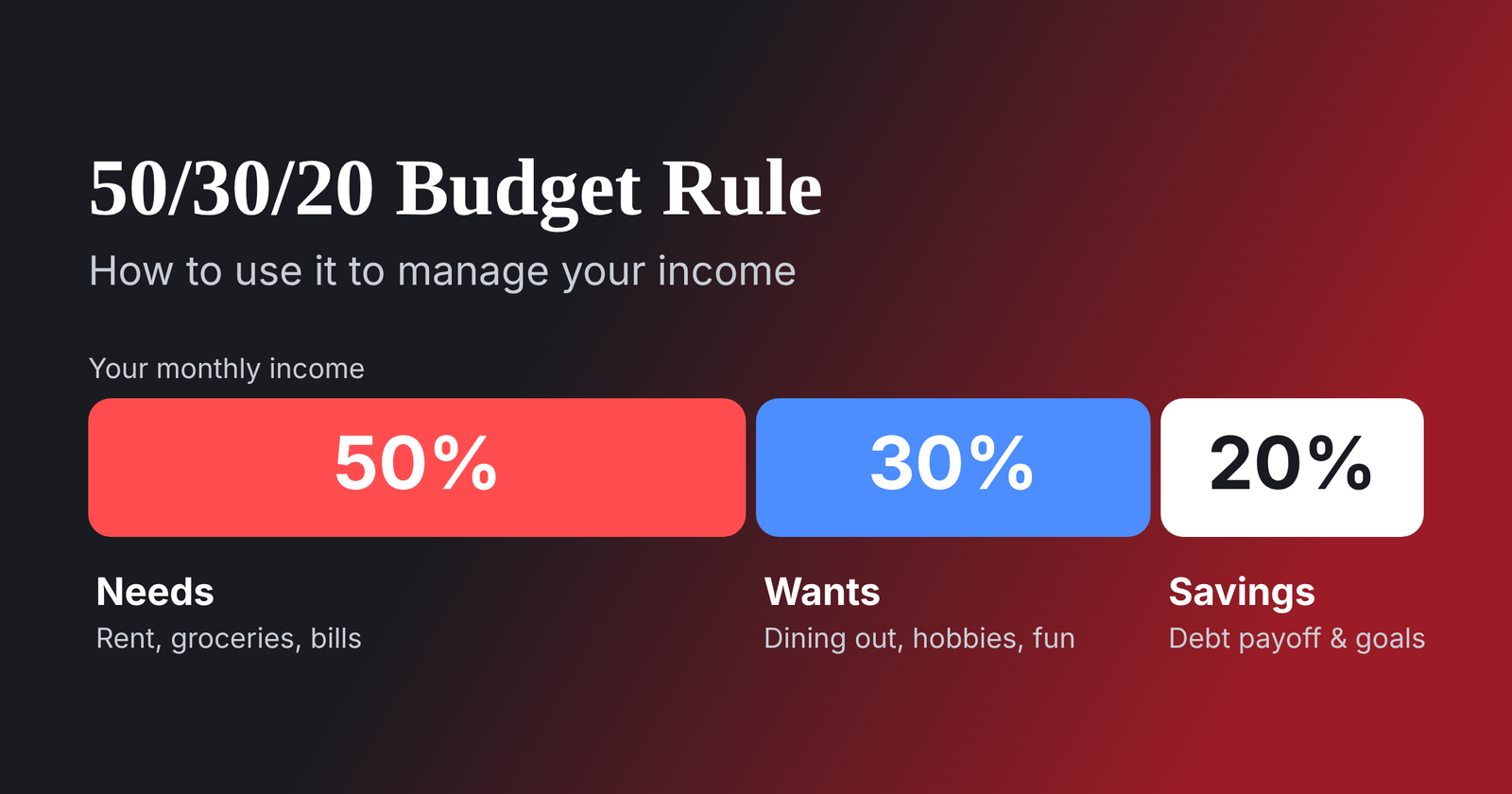
In short, the 50/30/20 budget rule says you should spend about 50% of your after-tax income on needs, 30% on wants and 20% on savings and debt repayment. It is a guideline, not a law, and it is designed to be easy to remember.
The 50/30/20 budget rule was popularised by U.S. Senator Elizabeth Warren and her daughter, Amelia Warren Tyagi, in their 2005 book All Your Worth: The Ultimate Lifetime Money Plan, as Fox Business explains. The authors used after-tax income, meaning the money that actually reaches your account after tax and deductions, rather than your gross pay.
Its appeal is simplicity. You do not need a complicated spreadsheet. You need a few honest numbers and a willingness to check them regularly.
How the 50/30/20 Budget Rule Works
Here is how the three categories break down:
| Category | Share of after-tax income | What it covers |
|---|---|---|
| Needs | 50% | Essentials you must pay to live and work |
| Wants | 30% | Things you choose that improve your life but are not essential |
| Savings and debt repayment | 20% | Emergency fund, goals, retirement and extra debt payments |
Needs (50%)
Needs are costs you cannot easily avoid. Typical examples are:
- Rent or mortgage payments
- Utilities such as electricity, water, heating and basic phone or internet
- Groceries (basic food, not restaurant meals)
- Essential transport to work or school
- Health care and necessary insurance
- Minimum payments on loans and credit cards
Wants (30%)
Wants are choices that make life more enjoyable. They include dining out, takeaways, streaming services, hobbies, holidays, gadgets, fashion and upgrades to essentials, such as a premium phone plan when a basic plan would do.
Savings and Debt Repayment (20%)
This bucket builds your future and reduces risk. It includes your emergency fund, savings goals, retirement contributions, investments and any payments above the minimum on debts. If you are not sure where to keep your savings, our guide to checking account vs savings account explains how to separate everyday money from long-term money.
7 Steps to Use the 50/30/20 Budget Rule
Step 1: Calculate Your Monthly After-Tax Income
Add up all the money you actually receive each month after tax and deductions. Include salary, regular side income and any other reliable payments. If your income varies, use your lowest typical month to stay safe. Using gross income is a common beginner mistake that makes every target too high.
Step 2: Work Out Your Three Targets
Multiply your take-home income by 0.50, 0.30 and 0.20. These are your starting limits for needs, wants and savings.
Step 3: List Your Actual Spending
Look at your last two or three months of bank and card statements. Write down every expense and note the amount. This step often reveals surprises, which is exactly why it is valuable. If you want a deeper walkthrough, read our guide on how to create a monthly budget.
Step 4: Sort Each Expense into a Bucket
Place every item in needs, wants or savings. Some items are not obvious, so ask yourself whether you would still need it if money got very tight. Here are some common gray areas:
| Expense | Usually a need when… | Usually a want when… |
|---|---|---|
| Groceries | Basic food for your household | Premium or ready-made foods |
| Phone plan | A basic plan you need for work or safety | A high-end plan with extra features |
| Car | You need it for work and have no alternative | A costly upgrade you could avoid |
| Internet | A basic connection for work or study | A faster, pricier package than you need |
| Insurance | Required or essential cover | Optional extras |
Step 5: Compare Your Totals with Your Targets
Add up each bucket and compare it with the target from Step 2. Most people discover that needs are higher than 50%, wants are higher than 30% or savings are lower than 20%. That is normal and nothing to be ashamed of. It simply shows where to adjust.
Step 6: Adjust Where It Makes the Most Difference
Start with the wants bucket, because it is the easiest to change. Our guide to 15 everyday expenses you can cut lists common leaks you can fix quickly. Next, look at needs, such as insurance, phone and energy bills, where a provider switch can reduce costs without hurting your lifestyle. If your needs are simply too high, do not give up. See the section below on adjusting the 50/30/20 budget rule.
Step 7: Automate Savings and Review Monthly
The most reliable way to apply the 50/30/20 budget rule is to pay yourself first. Set up an automatic transfer on payday for your savings and extra debt payments, then spend what remains within your needs and wants limits. Once a month, spend 20 minutes comparing your plan with your actual spending and adjust as needed.
A 50/30/20 Budget Rule Example
This is a hypothetical example for someone with a monthly take-home income of 3,000.
| Category | Target | Amount | Sample items |
|---|---|---|---|
| Needs | 50% | 1,500 | Rent 900, utilities 150, groceries 350, transport 100 |
| Wants | 30% | 900 | Dining out 250, subscriptions 50, entertainment 200, shopping 250, personal 150 |
| Savings and debt | 20% | 600 | Emergency fund 300, extra debt payment 200, goal savings 100 |
| Total | 100% | 3,000 |
Following this plan, the person saves 600 a month, or 7,200 a year, before any interest. Small, regular amounts also benefit from compounding over time, which is explained in our guide to compound interest.
When the 50/30/20 Budget Rule Does Not Fit
The 50/30/20 budget rule is a starting framework, and it will not suit every situation. It may feel unrealistic if you live in a high-cost area, have a low income, support a family or carry large debts. In those cases, adjust the percentages instead of abandoning the idea. Common variations include:
| Variation | Needs | Wants | Savings and debt | When it may help |
|---|---|---|---|---|
| 60/20/20 | 60% | 20% | 20% | Higher essential costs |
| 70/20/10 | 70% | 20% | 10% | Very tight budgets |
| 50/20/30 | 50% | 20% | 30% | Paying off debt or saving faster |
Here is a hypothetical example. Suppose your take-home pay is 2,000 and your needs already cost 1,300, which is 65%. You could use a 65/15/20 split:
| Category | Percentage | Amount |
|---|---|---|
| Needs | 65% | 1,300 |
| Wants | 15% | 300 |
| Savings and debt | 20% | 400 |
If even 20% feels impossible, start with a smaller savings share, such as 5% or 10%, and increase it when you can. Our guide on how to save money on a low income shows how to begin with small amounts. The goal is a plan you can actually follow.
Pros and Cons of the 50/30/20 Budget Rule
Advantages
- Very easy to understand and remember
- Needs only three categories, so there is less tracking
- Builds saving into your plan from the start
- Flexible enough to adjust to different incomes
- Works well as a first budget for beginners
Disadvantages
- Does not suit every income level or location
- The line between needs and wants can be blurry
- Does not show detailed spending, so small leaks may stay hidden
- Can make you feel behind if your needs exceed 50%
- Does not tell you how to split savings among goals and debts
If you want a more detailed system, you can combine the 50/30/20 budget rule with category tracking. Our guide to managing your money better shows how to build a full money routine.
Common Mistakes to Avoid
- Using gross income. Always base your percentages on take-home pay.
- Labelling wants as needs. A common mistake with the 50/30/20 budget rule is calling nearly everything a need, which makes the plan meaningless. Be honest.
- Ignoring irregular costs. Annual bills, repairs and gifts can break a budget. Divide them by twelve and include them in the right bucket.
- Forgetting about debt. Count minimum payments as needs and extra payments as part of the 20%. Not all debt is equal, so see our guide to good debt vs bad debt.
- Treating the percentages as strict rules. They are a guide. Adjust when your situation changes.
- Never tracking. A plan only works if you compare it with reality.
- Giving up after one bad month. Review what happened, adjust and continue.
- Skipping the emergency fund. Without a cushion, one surprise can push you back into borrowing.
Worldwide Advice vs. Country-Specific Rules
The 50/30/20 budget rule works in any currency, because it is based on percentages. But many details depend on where you live:
- Taxes and take-home pay: What counts as after-tax income depends on local tax and social contribution rules.
- Retirement and savings products: Account types, employer plans and tax treatment vary widely.
- Cost of living: Housing and transport costs differ greatly between countries and cities, which changes what is realistic.
- Debt and credit rules: Interest, fees and consumer protections are set locally.
- Benefits and support: Public benefits and discounts depend on national and local programmes.
For decisions involving tax, retirement or legal rights, check official government sources or a qualified local adviser. Please also read our Disclaimer for more detail.
Frequently Asked Questions
Is the 50/30/20 budget rule realistic?
For many people it is a useful starting point, but it may not match your real costs, especially in high-cost areas or on a low income. Treat it as a flexible guideline and adjust the percentages to fit your situation.
Does the 50/30/20 budget rule use gross or net income?
It uses net income, meaning your after-tax take-home pay. Using gross income would overstate how much you can spend or save.
Where does debt repayment go in the 50/30/20 budget rule?
Minimum payments on debts are usually counted as needs, because you are required to make them. Extra payments above the minimum belong in the 20% savings and debt category.
What if my needs are more than 50% of my income?
First, check whether any items are actually wants. If your needs are still higher, use an adjusted version such as 60/20/20 or 65/15/20, and look for ways to reduce essential costs over time. Even a small savings amount is better than none.
Can I use the 50/30/20 budget rule with irregular income?
Yes. Base your plan on your lowest typical month, cover needs first, and put extra income from stronger months into savings or a buffer. You can also pay yourself a steady monthly “salary” from a separate account.
Should I save before paying wants?
Yes, in most cases. Paying yourself first, by automating transfers to savings, makes it harder to spend the money by accident. You then use the remaining wants budget for enjoyment without guilt.
Conclusion
The 50/30/20 budget rule gives you a simple structure: half for needs, 30% for wants and 20% for savings and debt. It will not fit every situation perfectly, but it gives you a clear starting point and a way to measure your progress. If your numbers do not match, adjust the percentages and keep going.
Start this week by calculating your after-tax income and sorting last month’s spending into the three buckets. Set up an automatic transfer for savings, review once a month and fine-tune as your life changes. Used with honesty and flexibility, the 50/30/20 budget rule can turn a messy relationship with money into a plan you control.