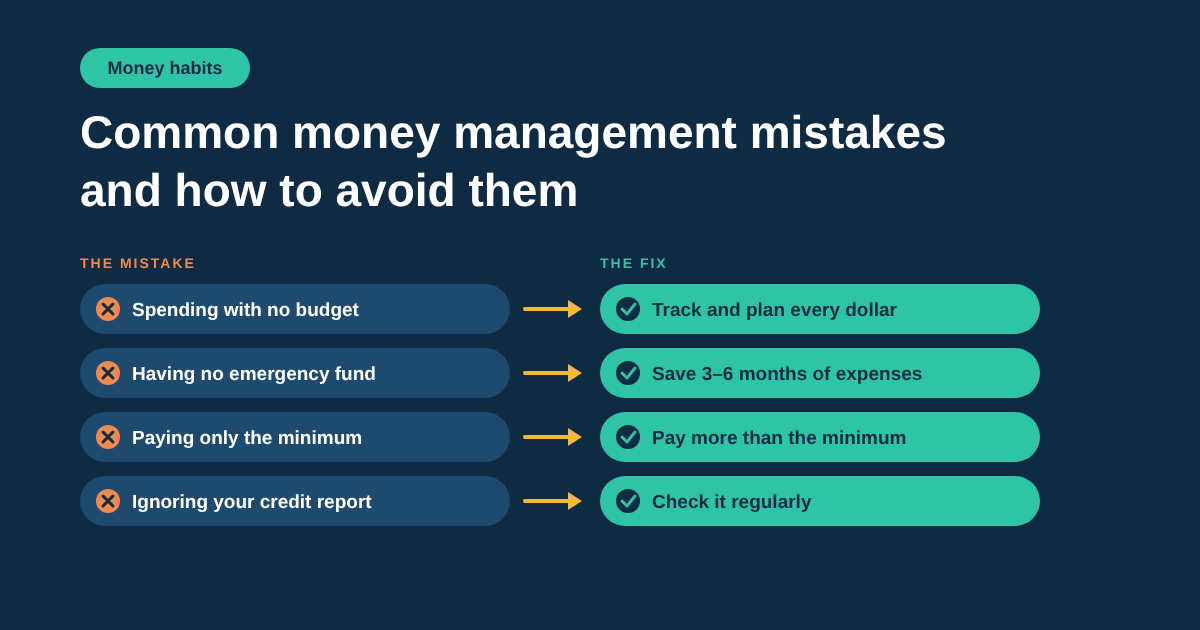
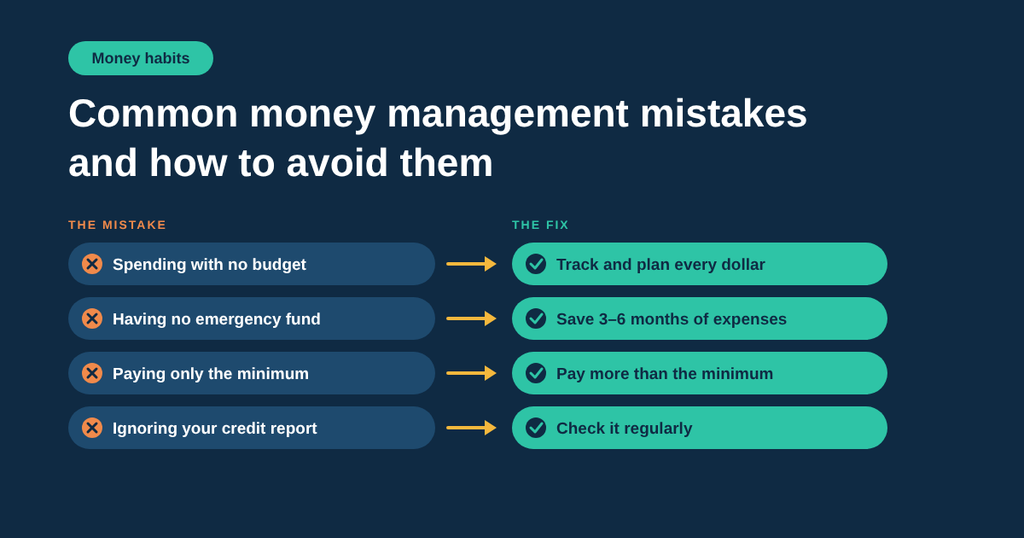
Money management mistakes rarely look dramatic when they happen. A forgotten subscription, a card balance you only partly pay, a savings plan you keep postponing: each seems small, yet together they can quietly drain your income for years. This guide is written for readers worldwide, so it uses neutral currency amounts and flags where national rules differ, such as tax, credit systems and consumer protection. It is general education, not personal financial, legal or tax advice.
In this article you will learn nine common money management mistakes, why each one hurts and a practical fix you can start this week. You will also see a hypothetical worked example, the habits that prevent these errors and answers to six frequently asked questions. If you want a foundation to build on, our guide on how to create a monthly budget is a good place to begin.
Table of Contents
- Why Money Management Mistakes Matter
- 9 Money Management Mistakes and How to Avoid Them
- Hypothetical Worked Example: The Cost of Money Management Mistakes
- Warning Signs You Need a Money Reset
- How to Build Habits That Prevent Money Management Mistakes
- Worldwide Advice vs. Country-Specific Rules
- Frequently Asked Questions
- Conclusion
Why Money Management Mistakes Matter
Most money management mistakes are not about earning too little. They are about decisions made on autopilot: spending without a plan, borrowing without a payoff strategy, or saving only when something is left over. Because these habits repeat every month, their cost compounds.
The good news is that these errors are fixable. You do not need a high income or financial expertise, only a clear picture of where your money goes and a few simple systems. Our guide on how to manage your money better covers the wider picture, and this article focuses on the specific traps that catch people most often.
9 Money Management Mistakes and How to Avoid Them
Work through the nine mistakes below and be honest about which ones apply to you. Fixing even two or three can make a noticeable difference.
Mistake 1: Living Without a Budget
Without a budget, money disappears into everyday spending and you only notice when the account runs low. A budget is simply a plan that gives every unit of income a job.
How to avoid it: list your take-home income, essential costs and spending, then set limits and a saving amount. Track your actual spending for 30 days to see what really happens. Our guide on how to create a monthly budget walks through the steps.
Mistake 2: Ignoring Small, Repeated Spending
A subscription you no longer use, daily convenience purchases and small fees feel harmless. Repeated every month, they become a significant yearly cost.
How to avoid it: review your last two or three statements, cancel what you do not use and set a weekly limit for small purchases. Our list of 15 everyday expenses you can cut gives you plenty of ideas.
Mistake 3: Having No Emergency Fund
Without a cash buffer, one unexpected bill, such as a repair, a medical cost or lost income, can force you to borrow. Consumer education guidance often suggests working toward three to six months of living expenses, although a smaller first milestone is more realistic if you are starting from zero.
How to avoid it: start with a small target, such as one month of essentials, and add to it automatically each payday. Keep the money somewhere accessible and separate from daily spending. Our comparison of checking account vs savings account explains where it can sit.
Mistake 4: Paying Only the Minimum on High-Interest Debt
Minimum payments keep your account in good standing, but they are designed to be low. ASIC’s consumer guidance explains that making only the minimum repayment each month means you will pay more interest and take longer to clear the balance. You can read this in ASIC’s loans and credit cards guidance. asic
This is one of the most expensive money management mistakes because interest works against you every month.
How to avoid it: pay more than the minimum whenever you can and direct extra money to your highest-interest debt first. Moneysmart’s credit card calculator shows how repaying a higher fixed amount reduces your balance and your interest costs. Our guide to paying off credit card debt faster sets out practical strategies. moneysmart
Mistake 5: Ignoring Your Credit Health
Late payments, maxed-out cards and constant new applications can damage your credit record, which may raise the cost of borrowing or limit your options.
How to avoid it: set up reminders or automatic payments for at least the minimum, keep balances well below your limits and check your credit report through your country’s official channels. Our guide on how to improve your credit score explains the main factors.
Mistake 6: Letting Your Lifestyle Rise With Every Pay Rise
When income grows and spending grows with it, you end up with a bigger lifestyle but no extra security.
How to avoid it: decide in advance how much of each raise or bonus goes to saving or debt repayment, for example half. Automate the transfer so the extra money never reaches your spending account.
Mistake 7: Saving Only What Is Left Over
If saving comes last, there is often nothing left. Vague intentions such as “save more” also rarely survive a busy month.
How to avoid it: pay yourself first by moving a fixed amount to savings on payday. Give that money a purpose, such as an emergency fund or a deposit, with an amount and a date.
Mistake 8: Delaying Long-Term Saving and Investing
Putting off retirement or long-term saving feels harmless in your twenties or thirties, but time is a major advantage. Our explainer on compound interest shows how growth can build on earlier growth.
How to avoid it: start with whatever amount you can afford, and increase it as your income rises. Investment returns are never guaranteed and values can fall as well as rise, so understand the risks and consider speaking to a regulated adviser or using official investor education resources.
Mistake 9: Falling for Scams and Get-Rich-Quick Offers
Scams are among the costliest money management mistakes because the money is usually unrecoverable. They often arrive as exciting offers or urgent warnings.
Watch for these red flags:
- Guaranteed or unusually high returns with no risk
- Requests for upfront fees or “release” payments
- Pressure to act immediately
- Unsolicited calls, messages or social media contacts
- Requests for your PIN, password or one-time codes
How to avoid it: pause, verify the company with your national financial regulator and never share security codes. If it sounds too good to be true, it usually is.
Hypothetical Worked Example: The Cost of Money Management Mistakes
The following example is hypothetical and uses a neutral currency. Imagine Sam, who takes home 2,400 per month (28,800 per year) and has a card balance of 2,500 at a 24% yearly interest rate. Interest is calculated monthly as balance × rate ÷ 12, and the balance is assumed to stay at 2,500 for the year.
| Money leak | How the monthly cost is calculated | Monthly cost | Annual cost |
|---|---|---|---|
| Unused subscriptions | 3 × 12 | 36 | 432 |
| Takeaway meals | 8 meals × 10 | 80 | 960 |
| Avoidable bank and ATM fees | Fixed | 6 | 72 |
| Card interest | 2,500 × 24% ÷ 12 | 50 | 600 |
| Total | 172 | 2,064 |
What These Money Management Mistakes Cost You
The leaks add up to 2,064 a year, about 7.2% of Sam’s yearly take-home pay (2,064 ÷ 28,800). Now see what happens after some simple fixes:
- Cancel all three unused subscriptions: saves 36 per month.
- Cut takeaway meals from 8 to 4: saves 4 × 10 = 40 per month.
- Avoid the extra bank fees: saves 6 per month.
That frees up 82 per month (36 + 40 + 6), or 984 per year (82 × 12). If Sam sends the 82 to the card, the balance drops from 2,500 to 1,516 after a year, ignoring interest in the meantime. The monthly interest on 1,516 at 24% is 1,516 × 24% ÷ 12 = 30.32, compared with 50 before. None of this required a higher income, only a few decisions.
Warning Signs You Need a Money Reset
You may be making money management mistakes if you recognise several of these:
- You are unsure how much you spent last month.
- You rely on credit cards or overdrafts to reach payday.
- You pay only the minimum on debts.
- You have less than one month of essentials saved.
- You often forget or miss payments.
- You feel stressed or avoid looking at your accounts.
If several apply, do not panic. Start with one step, such as tracking your spending for a month, and build from there.
How to Build Habits That Prevent Money Management Mistakes
Knowing the mistakes is not enough. Systems keep you on track when motivation fades.
- Automate the essentials: set up automatic transfers to savings and automatic payments for at least the minimum due on debts.
- Schedule a weekly check-in: ten minutes to review spending and upcoming bills helps you catch problems early.
- Review monthly: compare your actual spending with your budget and adjust.
- Review annually: revisit your goals, insurance, subscriptions and accounts. Many consumer education bodies also suggest checking your bank account regularly for better terms.
- Separate your money: keep spending, bills and savings in distinct accounts so you can see what is available.
- Celebrate progress: clearing a small debt or reaching a savings milestone reinforces the habit.
Consistency matters more than perfection. One missed week does not cancel the plan.
Worldwide Advice vs. Country-Specific Rules
The core habits of good money management apply everywhere. The legal and financial details do not.
| Applies worldwide | Check locally |
|---|---|
| Track income and spending with a budget | Tax rules on income, savings interest and investment gains |
| Build an emergency fund | Deposit protection schemes and how they work |
| Pay down high-interest debt first | Credit reporting, scoring and your rights to see your file |
| Automate saving and payments | Pension systems, employer contributions and retirement accounts |
| Beware of scams and guaranteed returns | Consumer protection laws and free, regulated debt advice |
Use the left column as your framework, then confirm the right column with your national regulator, tax authority or a qualified, regulated adviser. Our disclaimer explains that FASTDLS content is educational and not personal advice.
Frequently Asked Questions
1. What are the most common money management mistakes?
The most common money management mistakes include having no budget, ignoring small repeated spending, having no emergency fund, paying only minimums on debt and saving only what is left over. Falling for scams and delaying long-term saving are also frequent and costly. Most are fixed with simple habits and automation.
2. How do I stop overspending?
Start by tracking every expense for 30 days so you can see where the money goes. Then set realistic limits for your biggest categories and review them weekly. Waiting 24 hours before non-essential purchases can also reduce impulse buying.
3. How big should my emergency fund be?
Consumer education guidance often suggests working toward three to six months of essential living costs. If that feels out of reach, start with one month and build gradually. The right size depends on how stable your income is and how many people depend on it.
4. Should I pay off debt or save first?
For many people, a small emergency buffer comes first so a surprise cost does not create new debt. After that, extra money often goes to high-interest debt. Many money management mistakes come from treating this as all or nothing, so a balanced plan usually works best.
5. How long does it take to build better money habits?
There is no fixed timeline, because it depends on your situation and consistency. Small, repeated changes such as automatic saving and a monthly review tend to stick better than dramatic overhauls. Give yourself a few months and adjust as you go.
6. Can I fix these mistakes if I am already in debt?
Yes. Begin by listing every debt, paying at least the minimum on each and directing extra money to the highest-interest balance. Many countries also offer free, regulated debt advice services, so check your national regulator or government money guidance site.
Conclusion
Money management mistakes are common, but they are not permanent. By building a budget, trimming small leaks, creating an emergency fund, paying down expensive debt and protecting yourself from scams, you replace guesswork with a clear plan.
Remember the main lesson: avoiding money management mistakes is less about willpower and more about systems. Automate saving, schedule regular reviews and review your accounts at least once a year. Even small changes, like the 82 a month in our example, add up quickly.
Your next step is simple. Pick the one mistake from this list that feels most familiar, write down a single action to fix it and do it this week. Then come back to this list and tackle the next one, so money management mistakes become a thing of the past.