Understanding secured vs unsecured loans is one of the most important steps before you borrow, because the difference decides what you could lose if repayments become difficult. A secured loan is backed by something you own, while an unsecured loan is not. That single feature affects interest, borrowing limits, approval and risk. This guide is written for readers worldwide, so it uses neutral currency amounts and flags where national rules differ, such as repossession procedures and borrower protections. It is general education, not personal financial, legal or tax advice.
In this article you will learn how secured vs unsecured loans work, seven key differences, a hypothetical example comparing their costs and how to choose between them. You will also see the risks, common mistakes and answers to six frequently asked questions. If you are new to borrowing, our explainer on what is a personal loan is a helpful starting point.
Table of Contents
- Secured vs Unsecured Loans: The Short Answer
- What Is a Secured Loan?
- What Is an Unsecured Loan?
- Secured vs Unsecured Loans: 7 Key Differences
- Hypothetical Worked Example: Secured vs Unsecured Loans
- 7 Ways to Choose Between Secured vs Unsecured Loans
- Risks and What Happens If You Cannot Repay
- Common Mistakes to Avoid
- Worldwide Advice vs. Country-Specific Rules
- Frequently Asked Questions
- Conclusion
Secured vs Unsecured Loans: The Short Answer
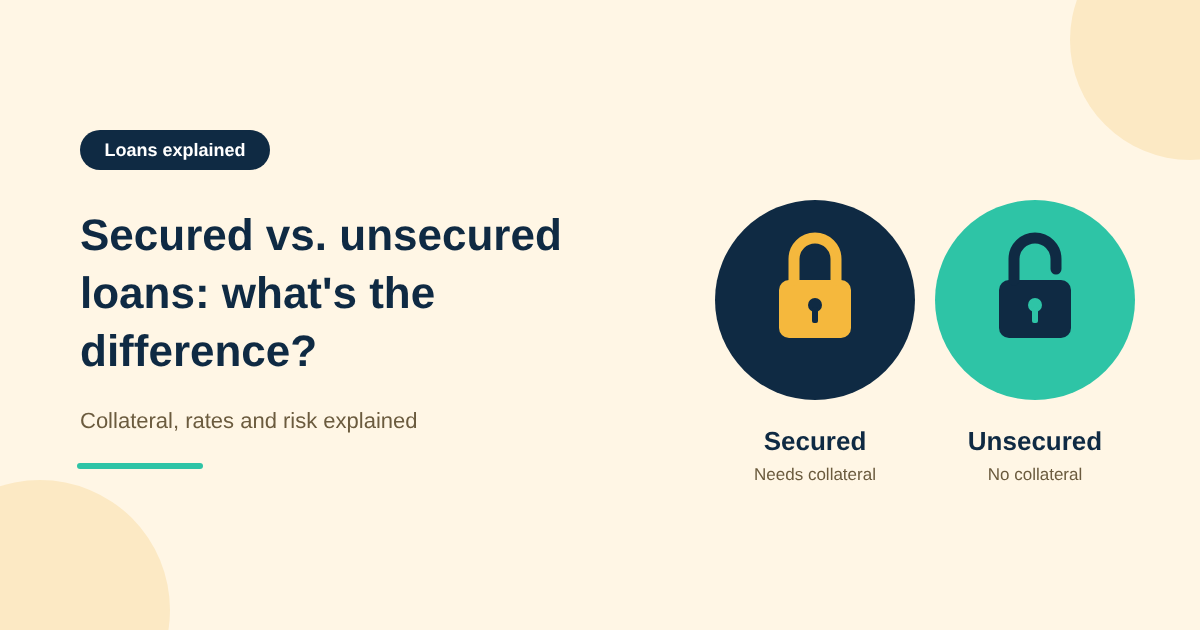
The short answer on secured vs unsecured loans is collateral. With a secured loan, you pledge an asset, such as a car or property, and the lender can take it if you do not repay. With an unsecured loan, you pledge nothing, so the lender relies on your promise to repay, your income and your credit record.
Moneysmart, Australia’s official consumer money site, explains it plainly: with a secured loan you provide an asset such as your car as security, and if you do not repay, the lender can take and sell it, while unsecured loans involve no security and usually have higher interest rates. You can read this on its personal loans page. moneysmart
What Is a Secured Loan?
A secured loan is borrowing backed by collateral, meaning something of value that gives the lender a way to recover its money if you stop paying. Because the lender’s risk is lower, secured loans often come with lower interest rates, larger borrowing limits and longer repayment terms.
Common examples include:
- Mortgages: the property is the collateral.
- Car loans: Moneysmart notes that most car loans are secured, with the car typically acting as the security, so the lender can repossess and sell it if you do not repay on time. See its car loans guide. moneysmart
- Secured personal loans: backed by an asset such as a vehicle or savings.
- Home equity borrowing: secured against the value you own in your property.
- Secured credit cards: these usually require a cash deposit as security.
The trade-off is risk. If you default, you may lose the asset, and in some places you may still owe money if it sells for less than the debt.
What Is an Unsecured Loan?
An unsecured loan has no collateral. The lender decides based on your credit history, income and ability to repay. Because the lender carries more risk, interest rates are usually higher and borrowing limits are often lower.
Common examples include:
- Most personal loans
- Credit cards
- Overdrafts
- Some student and education loans, depending on the country
- Store credit and many short-term loans
Some lenders ask for a guarantor, a person who agrees to repay if you cannot. Moneysmart notes that if you do not repay an unsecured loan, the lender can take legal action to recover the money. Our guide to paying off credit card debt faster covers one of the most common unsecured debts. moneysmart
Secured vs Unsecured Loans: 7 Key Differences
| # | Feature | Secured loan | Unsecured loan |
|---|---|---|---|
| 1 | Collateral | Required (such as a car or property) | Not required |
| 2 | Interest rate | Often lower | Often higher |
| 3 | Borrowing amount | Often higher | Often lower |
| 4 | Approval | May be easier with a fair credit record | Depends heavily on credit and income |
| 5 | Main risk | Losing the asset | Legal action, credit damage and higher cost |
| 6 | Speed | May take longer (valuation, paperwork) | Often quicker |
| 7 | Typical examples | Mortgage, car loan, secured personal loan | Personal loan, credit card, overdraft |
These are general patterns, not rules. Rates and terms depend on the lender, your circumstances and the country. A secured loan from one provider can cost more than an unsecured loan from another, so always compare the full cost.
Hypothetical Worked Example: Secured vs Unsecured Loans
The numbers below are hypothetical. The interest rates are invented for illustration and are not current or typical rates. Imagine someone borrowing 10,000 over 36 months, with a fixed monthly payment and interest calculated monthly.
| Loan type | Hypothetical yearly rate | Monthly payment | Total repaid | Total interest |
|---|---|---|---|---|
| Secured | 7% | About 308.77 | About 11,116 | About 1,116 |
| Unsecured | 13% | About 336.94 | About 12,130 | About 2,130 |
What the Secured vs Unsecured Loans Numbers Show
- Cost: in this example the unsecured loan costs about 1,014 more in interest (12,130 − 11,116).
- Monthly payment: it is about 28.17 higher each month (336.94 − 308.77).
- Risk: the secured loan’s lower cost comes with a trade-off. Suppose the borrower stops paying after 12 months, when about 6,896 is still owed. If the lender sells the pledged asset for 5,500 after costs, a shortfall of about 1,396 (6,896 − 5,500) could remain, depending on local rules.
The lesson is that secured vs unsecured loans differ in cost and in what is at stake. The secured loan is cheaper here, but a default puts the asset and possibly more money at risk. The comparison depends entirely on your real quotes, fees and terms, so ask lenders for the full cost and use an official loan calculator.
7 Ways to Choose Between Secured vs Unsecured Loans
Use these seven checks to decide which kind of loan fits your situation.
- Start with the purpose. Buying a home or a vehicle usually involves secured lending. Flexible or smaller needs often suit an unsecured loan.
- Know what you could lose. Ask whether you are prepared to risk the asset. If losing it would be a serious problem, think carefully.
- Compare the total cost. Look at interest, fees and the overall amount repaid, not just the headline rate.
- Check the terms. Look at the loan length, whether the rate is fixed or variable and any fees for repaying early.
- Review your credit record. Better credit usually improves your options. Our guide on how to improve your credit score explains the main factors.
- Test affordability with a budget. Build the repayment into a realistic plan, including a cushion. Our guide on how to create a monthly budget shows how. Our explainer on good debt vs bad debt can also help you judge whether the borrowing makes sense.
- Verify the lender. Confirm the lender is licensed or regulated in your country. Be wary of anyone asking for an upfront fee before lending, guaranteeing approval or pressuring you to sign quickly.
Risks and What Happens If You Cannot Repay
Both loan types carry risk, but the consequences differ.
Secured loans. If you fall behind, the lender may be able to take the asset and sell it. Moneysmart advises that when you borrow against a car or goods and fall behind, the lender may repossess and sell the asset, and if you receive a default notice you should not ignore it and should talk to your lender or get free legal advice right away. Its page on repossessed goods explains the process in Australia. moneysmart
Unsecured loans. The lender cannot simply take an asset, but it can pursue the debt through collections or legal action, and your credit record can suffer.
If you are struggling:
- Contact the lender early and ask about hardship options.
- Do not ignore letters or default notices.
- Seek free, regulated debt advice where it is available.
- Avoid paying anyone upfront to “fix” your debt.
Common Mistakes to Avoid
- Ignoring what is at stake: with secured vs unsecured loans, the biggest difference is what you could lose.
- Choosing on the rate alone: fees, loan length and conditions all change the real cost.
- Borrowing more than you need: a larger loan costs more and raises the risk.
- Skipping the budget check: a payment that fits today may not fit if your income dips.
- Using your home for small, short-term needs: the risk can far outweigh the benefit.
- Missing default notices: early action gives you more options.
- Falling for loan scams: upfront fees, guaranteed approval and urgent deadlines are classic warning signs.
Worldwide Advice vs. Country-Specific Rules
The core idea of collateral is universal. The legal details are not.
| Applies worldwide | Check locally |
|---|---|
| A secured loan is backed by an asset and an unsecured loan is not | What counts as collateral and how it must be registered |
| Compare the total cost, not just the rate | Repossession and enforcement rules, including court involvement |
| Borrow only what you can afford | Whether you still owe money if the asset sells for less than the debt |
| Protect yourself against scams | Interest rate caps, fee rules and borrower protections |
| Act early if you fall behind | Credit reporting, insolvency and free debt advice services |
Use the left column as your framework, then confirm the right column with your national regulator, consumer protection agency or a qualified, regulated adviser. Our disclaimer explains that FASTDLS content is educational and not personal advice.
Frequently Asked Questions
1. What is the main difference between secured vs unsecured loans?
The main difference between secured vs unsecured loans is collateral. A secured loan is backed by an asset the lender can take if you do not repay, while an unsecured loan is not. This usually affects interest rates, borrowing limits and the risk to you.
2. Which is cheaper, a secured or an unsecured loan?
Secured loans are often cheaper because the lender’s risk is lower, but this is not guaranteed. Fees, loan length and your credit record all affect the cost. Always compare the total amount you would repay.
3. Can I lose my home with a secured loan?
Yes, if your home is the collateral and you default, the lender may be able to take it, subject to local law and procedures. This is why it is important to borrow carefully and act quickly if you struggle. Rules vary widely by country.
4. Is a credit card secured or unsecured?
Most credit cards are unsecured. Some cards, called secured cards, require a cash deposit that acts as collateral. Both types charge interest on unpaid balances.
5. Is an unsecured loan easier to get?
Not necessarily. Unsecured lending depends heavily on your credit record and income, while a secured loan may be easier to obtain if you have an asset to offer. Approval criteria differ between lenders and countries.
6. Can I switch from one type of loan to the other?
Sometimes. You may be able to refinance, which means replacing one loan with another, but fees, exit charges and new terms can offset the benefit. Compare the full cost before you switch, and consider speaking to a regulated adviser.
Conclusion
Secured vs unsecured loans come down to a simple trade-off: security for the lender, risk for you. Secured loans often offer lower rates and higher limits in exchange for putting an asset on the line, while unsecured loans protect your property but usually cost more and rely on your credit record.
Remember the seven checks: know your purpose, understand what you could lose, compare total costs, read the terms, review your credit, test affordability and verify the lender. When you weigh secured vs unsecured loans this way, you are far more likely to borrow with confidence.
Your next step is simple. Write down how much you need, what you could pledge and what you can comfortably repay each month, then ask two or three regulated lenders for the full cost of each option. Compare secured vs unsecured loans using real quotes before you sign anything.