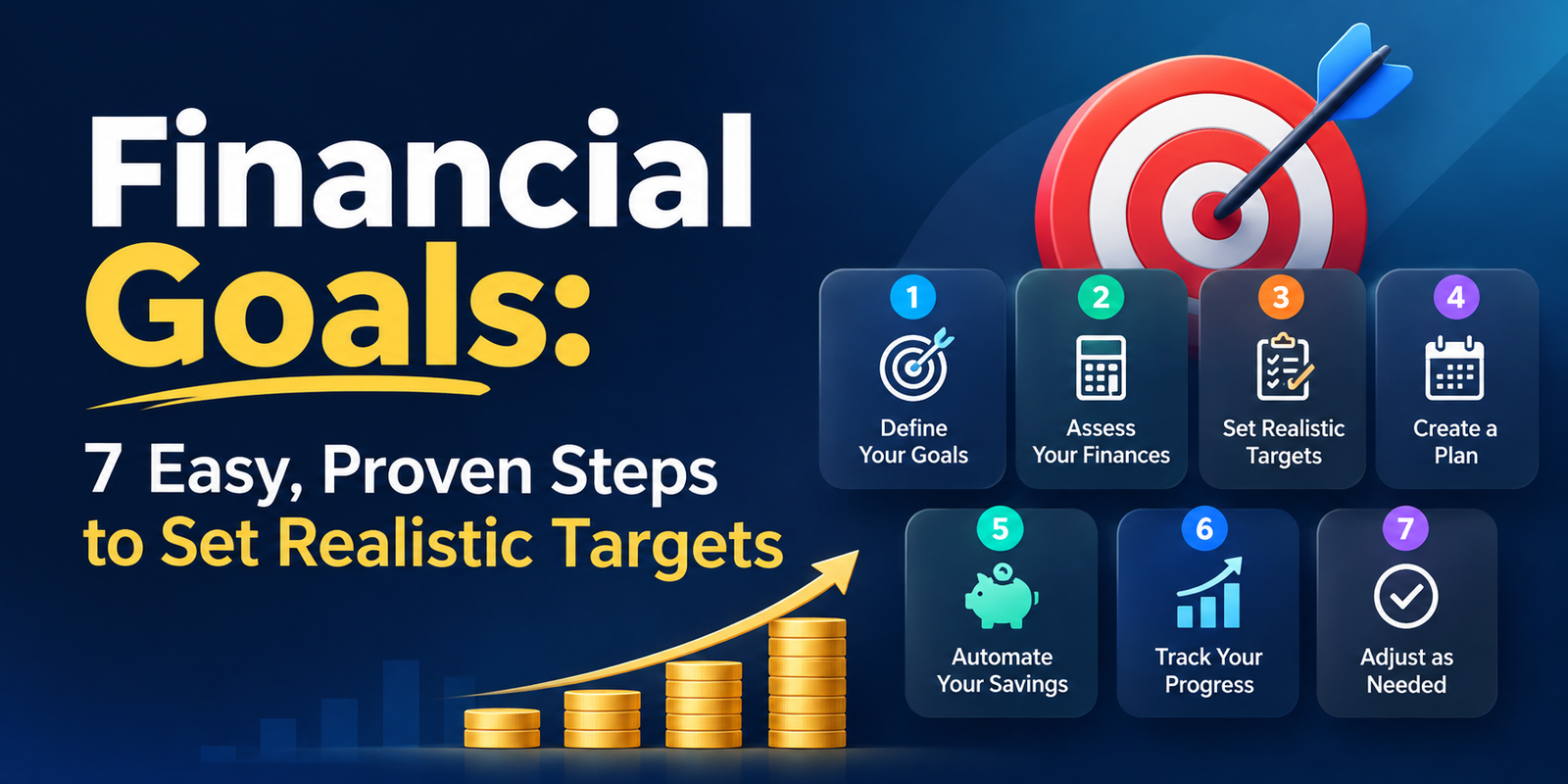
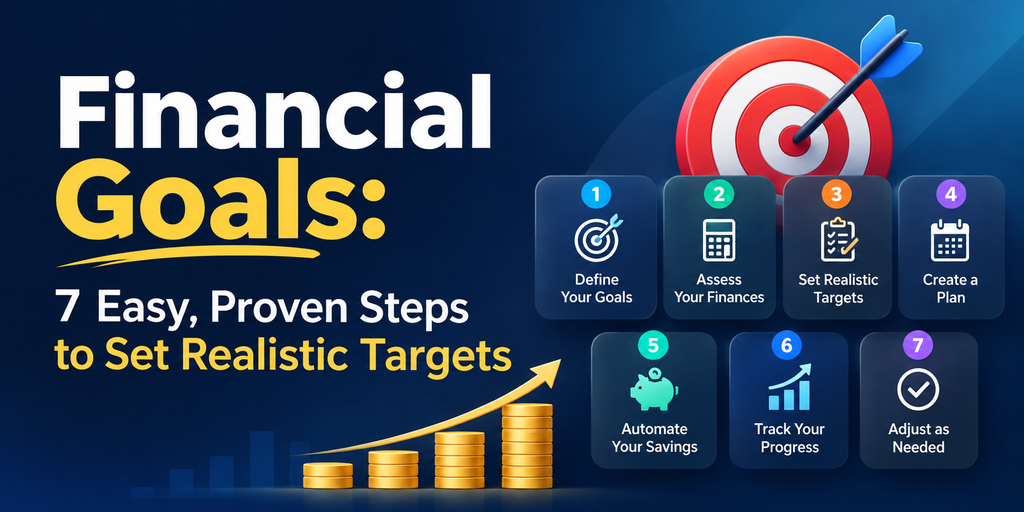
Setting realistic financial goals is one of the most useful habits you can build if you want your money to support the life you actually want. Without a clear target, income tends to disappear into daily spending, and saving becomes something you plan to do “later”. This guide is written for readers anywhere in the world, so the principles apply whether you earn dollars, pounds, euros, naira, rupees or any other currency. Rules on tax, benefits, retirement accounts and deposit protection differ by country, and we flag those differences as we go. Everything here is general education, not personal financial, legal or tax advice.
In this article you will learn how to separate short-term and long-term financial goals, make each one specific and measurable, and decide what comes first when you want everything at once. You will also see a worked hypothetical example, the most common mistakes and answers to six frequently asked questions. A written budget is what turns financial goals into monthly actions, so our guide on how to create a monthly budget is a natural companion to this one.
Table of Contents
- What Are Financial Goals and Why Do They Matter?
- Short-Term vs Long-Term Financial Goals
- Start With Your Values and Your Starting Point
- How to Make Your Financial Goals SMART
- How to Set Realistic Short-Term Financial Goals
- How to Plan Long-Term Financial Goals
- A Hypothetical Worked Example
- How to Prioritise Competing Goals
- How to Track and Adjust Your Progress
- Common Mistakes to Avoid
- Worldwide Advice vs. Country-Specific Rules
- Frequently Asked Questions
- Conclusion
What Are Financial Goals and Why Do They Matter?
Financial goals are specific outcomes you want your money to achieve, such as clearing a debt, building a safety net, buying a home or retiring comfortably. They turn vague wishes like “I want to be better with money” into targets you can measure and plan for.
Well-chosen goals do three jobs:
- Direction: they tell you what to do with spare money instead of leaving it to chance.
- Motivation: visible progress makes it easier to keep going when temptation appears.
- Clarity on trade-offs: they help you decide which purchases support your priorities and which do not.
Moneysmart, the consumer education site run by Australia’s securities regulator, notes that writing goals down may make them more likely to happen. That is why a written plan usually beats a mental one. moneysmart
Short-Term vs Long-Term Financial Goals
A simple way to organise your financial goals is by time horizon. Many people use three bands:
| Horizon | Typical timeframe | Examples | Main priority |
|---|---|---|---|
| Short-term | Up to 1 year | Starter emergency fund, clearing a small debt, a planned purchase | Stability and quick wins |
| Medium-term | 1 to 5 years | Home deposit, vehicle, course fees, wedding | Steady saving with low risk |
| Long-term | 5 years or more | Retirement, children’s education, financial independence | Consistency, growth and protection from inflation |
Time horizon also shapes where money sits. Money you need within a year or two is usually kept somewhere accessible and low risk, while money for goals decades away may be able to ride out more ups and downs. Our comparison of checking account vs savings account explains where everyday and short-term money often belongs. Investing involves risk and nothing is guaranteed, so check with a regulated adviser or official source before choosing investments.
Start With Your Values and Your Starting Point
Before you pick numbers, get two things clear.
What matters to you. Write down what you want money to do for you over the next one, five and twenty years. Security, flexibility, family, education, travel and generosity are common answers. Targets built on your own values are far easier to stick with than targets borrowed from someone else’s life.
Where you stand today. Gather four figures: monthly take-home income, essential spending (housing, food, transport, utilities and minimum debt payments), total savings and total debts. The gap between income and essentials shows how much room you realistically have. If that gap is small or negative, begin with our guide on how to save money on a low income and rely on small, consistent steps rather than ambitious targets.
How to Make Your Financial Goals SMART
SMART is a goal-setting framework used by many financial education bodies. India’s securities regulator, for example, describes a good goal as specific, measurable, achievable, realistic and time bound, as shown on its investor education page. sebi
- Specific: say exactly what you want and why.
- Measurable: attach a number so you can track progress.
- Achievable: make sure it fits your income and obligations.
- Realistic: check it against your current life, not an ideal version of it.
- Time-bound: set a deadline so the target has urgency.
From Vague to SMART
- Vague: “Save more money.”
- SMART: “Build an emergency fund of 3,000 in 12 months by moving 250 into savings on payday each month.”
The arithmetic is simple but essential: 250 × 12 = 3,000. If the monthly amount multiplied by the number of months does not equal the target, the plan does not work yet.
A Quick Test for Your Financial Goals
Ask five questions of every target you set:
- Can I state it in one sentence with a number and a date?
- Does the monthly amount fit inside my budget after essentials?
- Do I know why it matters to me?
- What could derail it, and what is my fallback?
- When will I review it?
If any answer is “no”, adjust the plan before you start.
How to Set Realistic Short-Term Financial Goals
Short-term targets cover roughly the next 12 months. They matter because quick wins build the confidence to keep going. Typical examples include a starter emergency fund, paying off a small balance, saving for a planned expense or cutting one recurring cost.
Build a starter safety net
An emergency fund is a common first target. Consumer guidance often suggests building up to enough to cover three to six months of living expenses, as this official consumer education page explains. If you are starting from zero, a smaller first milestone, such as one month of essentials, is more realistic and still protects you from many surprises. militaryconsumer
Deal with high-cost debt
Debt with a high interest rate can undo your saving, because the interest works against you every month. If you carry card balances, our guide to paying off credit card debt faster sets out practical strategies. Our explainer on good debt vs bad debt can also help you judge which borrowing deserves attention first.
Plan for irregular expenses
Annual insurance, school fees, holidays and repairs are predictable even when their timing is not. Divide each yearly cost by 12 and set that amount aside monthly, so these bills never become emergencies.
How to Plan Long-Term Financial Goals
Long-term targets such as retirement, a home or education need a different approach, because the sums are large and the dates are distant. Work backwards:
- Estimate the future cost in today’s money.
- Allow for inflation, since prices usually rise over time.
- Divide the amount by the number of months available to get a baseline monthly figure.
- Review the plan at least once a year.
Time can be a powerful ally. Our explainer on compound interest shows how earnings on earnings can make steady contributions grow. Investment returns are never guaranteed, however, and values can fall as well as rise, so treat any calculator projection as an illustration rather than a promise.
Scam warning: be cautious of any offer that guarantees returns, asks for upfront fees or pressures you to decide quickly. Genuine long-term plans are usually gradual and unexciting.
A Hypothetical Worked Example
The following example is hypothetical. It uses a neutral currency unit so it works anywhere. Imagine Amira, who takes home 2,800 per month and has essential costs of 1,600. She has already saved 600.
| Goal | Horizon | Target | Calculation | Monthly saving |
|---|---|---|---|---|
| Starter emergency fund (3 months of essentials) | Short-term | 4,800 (3 × 1,600), with 600 already saved | 4,200 ÷ 12 months | 350 |
| Holiday | Short-term | 1,800 in 18 months | 1,800 ÷ 18 months | 100 |
| Home deposit | Long-term | 18,000 in 6 years | 18,000 ÷ 72 months | 250 |
| Total | 700 |
Her monthly plan adds up like this: 1,600 for essentials plus 700 for her targets plus 500 for everyday wants equals 2,800, exactly her take-home pay.
Now look at what happens after 12 months. The emergency fund is complete, so Amira can redirect the 350. Her deposit fund holds 3,000 (250 × 12), leaving 15,000 to save. At 600 a month (250 + 350), that takes 25 months (15,000 ÷ 600), so she could reach the deposit in about three years instead of six. This ignores interest, inflation and the end of the holiday saving, all of which would change the real result. The lesson is that sequencing your financial goals can shorten the timeline without raising your monthly saving.
How to Prioritise Competing Goals
If you cannot fund everything at once, a common order for many people looks like this:
- Cover essentials and any legally required payments.
- Build a small starter emergency fund.
- Reduce high-interest debt.
- Grow the emergency fund towards a fuller target.
- Fund long-term targets such as retirement or a home deposit.
Your own order may differ. Some countries offer employer pension contributions, tax-advantaged accounts or government savings schemes that change the maths, so check with a regulated adviser or official source. When financial goals compete, ask which one costs the most if you delay it. Interest on a high-cost debt usually answers that question quickly.
How to Track and Adjust Your Progress
A plan only works if you look at it. Set a short monthly review, about ten minutes, and compare your actual saving with the plan. A simple spreadsheet, notebook or progress bar is enough.
- Automate: schedule transfers on payday so saving happens before spending.
- Celebrate milestones: reaching one month of essentials is worth noticing.
- Reset when life changes: a new job, a baby, a move or a rate change are all good reasons to recalculate.
Adjusting a target is not failure. It is how realistic plans survive real life.
Common Mistakes to Avoid
- Vague targets: “be rich” or “save more” cannot be measured.
- Setting too many financial goals: three or four active targets are usually easier to manage than ten.
- Ignoring emergencies: without a buffer, one surprise bill can push you back into debt.
- Forgetting inflation: a long-term sum that looks large today may buy less later.
- Chasing high returns: promises of fast, guaranteed profit are a classic warning sign of fraud.
- Never reviewing: a plan written once and never checked drifts out of date.
- Giving up after one bad month: missing one deposit does not cancel the plan. Resume the next month.
Worldwide Advice vs. Country-Specific Rules
The core habits of goal setting are universal. The details of tax, benefits and protection are not.
| Applies worldwide | Check locally |
|---|---|
| Write specific, measurable, time-bound targets | Tax treatment of savings, interest and investments |
| Build an emergency buffer before taking risks | Deposit protection limits and which institutions are covered |
| Pay attention to high-cost debt | Retirement account types, contribution limits and employer schemes |
| Review progress regularly | Credit reporting systems and borrowing rules |
| Beware of guaranteed-return offers | Interest rate rules, fees and consumer protections |
Use the principles on the left as your foundation, then confirm the rules on the right with your national regulator, tax authority or a qualified, regulated adviser. Our disclaimer explains that FASTDLS content is educational and not personal advice.
Frequently Asked Questions
1. How many financial goals should I have at once?
Most people find three to five active targets manageable. Having too many spreads your money thin and slows every one of them. Focus on the most urgent short-term target and one long-term target, then add more as you complete them.
2. What are examples of short-term goals?
Common examples include saving one month of essential expenses, paying off a small debt, building a fund for annual bills or setting aside money for a planned trip. They usually take under a year and give you early momentum.
3. What are examples of long-term goals?
Typical examples include retirement savings, a home deposit, children’s education and financial independence. Because they span many years, they benefit from regular contributions and an annual review. Returns on any investment are never guaranteed.
4. How do I know if my financial goals are realistic?
Divide the target by the months available and compare the result with the spare money in your budget. If the monthly figure does not fit after essentials, extend the deadline or reduce the target. A smaller plan you can follow beats a bigger plan you abandon.
5. Should I save or pay off debt first?
For many people, a small starter emergency fund comes first, so one surprise does not force new borrowing. After that, high-interest debt often deserves priority because the interest cost is certain. Your situation may differ, so consider speaking to a regulated adviser or a recognised debt advice service.
6. How often should I review my goals?
A quick monthly check and a deeper annual review work well for most people. Also review after any major life event such as a new job, a move or a change in family size. Regular reviews keep the numbers realistic.
Conclusion
Financial goals give your money a job, and realistic ones give you a plan you can actually follow. By splitting your targets into short-term and long-term horizons, making each one SMART and testing the monthly maths, you replace wishful thinking with a clear path.
Remember the key steps: know your starting point, build a safety net, tackle costly debt, work backwards from long-term sums and review regularly. Strong financial goals are not about perfection. They are about steady progress, adjusted as your life changes.
Your next step is simple. Pick one short-term target and one long-term target today, write each as a single SMART sentence and set up your first automatic transfer. Then open your budget and make sure your financial goals have a place in it. If you want help with the budgeting side, start with our guide on how to manage your money better.